10 Tray Baking Tips for Choosing the Right Tray?
Choosing the right tray can change more than a cake’s appearance. It can alter browning, moisture, texture, and baking time. In Tray Baking, small choices matter. A dark steel tray may create crisp, deeply colored edges. A pale aluminum tray usually supports gentler browning. Even a few millimeters of thickness can affect heat movement.
Industry data supports this growing attention to bakeware. Grand View Research’s Bakeware Market Size, Share & Trends Analysis Report identifies material quality, durability, and household baking demand as important market factors. Meanwhile, the IMARC Group’s bakeware market analysis highlights continued interest in practical, reusable kitchen products. These reports do not make tray selection simple. They do show why performance matters beyond appearance.
PJ Hamel, a longtime baking writer and educator at King Arthur Baking Company, states, “The darker the pan, the darker the crust.” That advice is useful, but it is not universal. Oven temperature, recipe sugar, rack position, and tray thickness also matter. I have overbaked thin cookies by trusting the timer too much. The tray gave me a warning first: dark edges, a dry center, and butter marks beneath the dough. I ignored it.
This guide explores ten practical Tray Baking tips for choosing the right tray. It considers material, color, size, depth, rim design, heat response, cleaning, and long-term value. Some recommendations will be straightforward. Others require testing. No tray is perfect. Your oven may disagree.
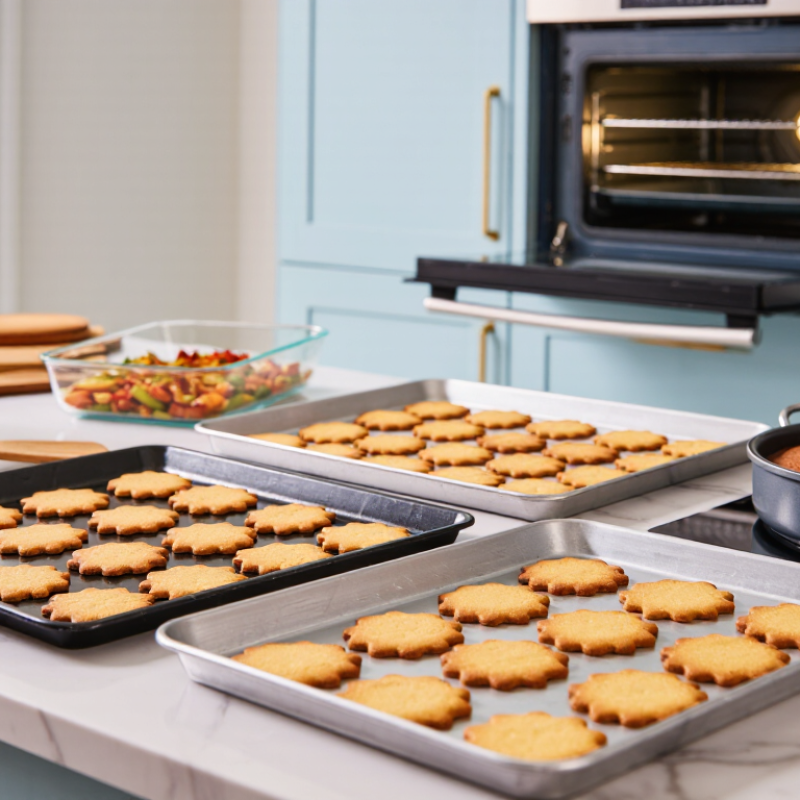
Identify the Right Tray Type for Your Baking Recipe
Choosing the Right Tray: Identify the Right Tray Type for Your Baking Recipe
Tray choice changes heat flow, texture, and baking time. For crisp cookies, choose a light-colored aluminum tray. It reflects more heat and reduces excessive browning underneath. A dark tray absorbs heat faster, which may help brownies develop firm edges. I still misjudge this difference sometimes. Check the base after ten minutes.
For cakes, use a sturdy metal pan with straight sides. Metal transfers heat quickly, helping the batter set evenly. Glass retains heat longer, so reduce the oven temperature slightly and watch the edges. The U.S. Department of Agriculture recommends 160°F for egg dishes, reminding bakers that internal temperature matters beyond appearance. Tray depth also matters. A deep pan slows the center, while a shallow tray encourages faster moisture loss.
Tip: Match the tray to the recipe’s structure. Use a rimmed sheet for roasting or sticky dough. Use a loose-bottom pan for delicate tarts. Line only when needed, because excessive paper can weaken browning.
The 2024 IMARC Group bakeware market analysis values the global market at approximately US$3.3 billion, reflecting broad demand for specialized baking equipment. Yet more options can create confusion. A silicone tray offers easy release but may need support from a rigid baking sheet. The U.S. Energy Information Administration reports that oven cooking uses substantial household energy, so avoid repeated testing. Small choices matter. Rotate the tray only when the recipe allows it.
Choose the Best Tray Material for Heat Distribution
In a working kitchen, tray material changes how quickly heat reaches the batter. That difference affects crust color, rise, and moisture. Light-colored aluminum usually spreads oven heat quickly and evenly. A thicker tray performs better than a flimsy one. It resists hot spots near the oven walls.
Choose a pale surface for gentle browning. Dark metal absorbs more heat and can deepen edges quickly. Use it for crisp cookies, but reduce the temperature slightly when needed. Aluminized steel offers useful strength and fairly steady heating. Thin steel can warp. It may also leave pale centers and dark corners. Stainless steel is durable, but it conducts heat less efficiently than aluminum. Glass heats more slowly, then holds heat longer. It suits casseroles and soft, gradual browning. Ceramic behaves similarly. It retains heat well, though it can make timing less predictable.
Keep the tray flat. A warped base spreads heat unevenly. Match the tray size to the recipe, because excess empty space encourages browning. Leave room between portions so hot air can circulate. Preheat the oven fully, not just until the indicator changes. Line the tray carefully, since wrinkled paper can lift cookie edges. Rotate the tray only when your oven has clear hot spots. Measure the first batch closely. My own test batches are not always perfect, especially with dark trays, so I record edge color and center texture. A simple oven thermometer can reveal inaccurate settings. Heat distribution deserves testing, not guessing.
10 Tray Baking Tips for Choosing the Right Tray
Choose the Best Tray Material for Heat Distribution
How to read the chart: Thermal conductivity shows how quickly heat spreads through a tray material. Higher values generally support faster heat distribution, while lower-conductivity materials may heat more slowly and gently. Actual baking results also depend on tray thickness, color, oven temperature, surface finish, and recipe.
- Choose aluminum for fast and generally even heat distribution.
- Use carbon steel when you want strong heat retention and durability.
- Consider stainless steel for corrosion resistance, but expect slower heat spreading.
- Use glass when gradual heating and visible browning are useful.
- Choose ceramic for steady heat retention in oven-to-table baking.
- Prefer light-colored trays when you want to reduce excessive browning.
- Use dark trays carefully because they absorb more radiant heat.
- Select a thicker tray to reduce warping and improve temperature stability.
- Leave space between trays to support airflow and more even baking.
- Match the tray material to the recipe, baking temperature, and desired crust color.
Values are representative room-temperature thermal-conductivity figures in W/m·K. Material composition and manufacturing can cause variation. Match Tray Size and Shape to Your Baking Needs
10 Tray Baking Tips for Choosing the Right Tray
Match Tray Size and Shape to Your Baking Needs
A tray should match the recipe, not merely fit your oven. Before baking, measure its length, width, and depth. A small tray makes batter thicker, so the center may stay wet while the edges darken. A larger tray spreads batter thinly, shortening the baking time and creating crispier edges.
For brownies, choose a square or rectangular tray with straight sides. Use a shallow sheet tray for cookies, roasted vegetables, or thin sponge cakes. A deeper tray suits lasagna, bread pudding, and cakes that need room to rise. Round trays work well for layered cakes, while loaf trays support dense breads and pound cakes. Check the recipe’s volume when changing shapes. Two smaller trays may bake more evenly than one deep tray.
Leave space around the tray for hot air to circulate. Do not crowd cookies; their edges need room to brown. Light-colored metal usually gives gentler browning, while dark surfaces can darken food faster. Glass and ceramic trays may heat differently, so watch the first batch carefully. I once trusted the stated baking time and burned a thin cake. That mistake still influences my checks. Rotate the tray only when the recipe allows it. Measure the batter, watch the edges, and adjust gradually. Perfect results are not guaranteed. Careful observation matters more.
Check Tray Depth, Surface, and Nonstick Features
Choosing the right baking tray starts with depth. A shallow tray spreads heat quickly and suits cookies, biscuits, and thin pastries. A deeper tray holds more batter for brownies, layered cakes, or roasted vegetables. However, extra depth can slow the center from cooking. Check the recipe before choosing size.
I once used a deep tray for a delicate sponge, and the edges browned before the middle set. That mistake still influences my choices.
The surface matters just as much. Light-colored metal usually reflects heat and supports gentler browning. Dark surfaces absorb more heat, so edges may crisp sooner. Glass and ceramic trays often retain heat longer, requiring careful timing. Nonstick coatings help release sticky cakes and reduce scrubbing. They do not replace preparation, though. A light coating of oil or parchment can protect fragile mixtures. Avoid metal tools, since scratches can weaken the surface over time. Inspect the tray regularly for peeling, warping, or rough patches. A warped tray may tilt batter toward one corner. Not ideal. Also, measure the inside dimensions, not only the outer rim. Small differences can change baking time and texture. When uncertain, test one batch and record the result. Your oven, ingredients, and tray may behave differently next time.
Compare Durability, Cleaning, and Storage Requirements
10 Tray Baking Tips for Choosing the Right Tray
A durable tray should resist warping, staining, and scratched surfaces. Check its thickness first. A heavier tray usually holds heat more evenly, but it also demands more storage space. Look for straight edges and a firm rim. Avoid trays that flex when lifted with one hand. Choose a finish that tolerates metal spatulas, although soft coatings still need care. The International Aluminium Institute reports that recycling aluminium uses about 95% less energy than producing primary aluminium. This makes recyclable metal a practical long-term choice, not merely a trendy one.
Cleaning needs equal attention. Select a tray with smooth corners, limited rivets, and no deep grooves. Crumbs hide there. Warm water and mild detergent often remove fresh grease more safely than aggressive scrubbing. The U.S. Food and Drug Administration advises cleaning food-contact surfaces thoroughly and preventing residue buildup. Never assume “dishwasher-safe” means maintenance-free. Repeated high heat can dull finishes or promote corrosion on unsuitable materials. I once chose a tray with excellent heat retention but awkward corners. It baked well and cleaned badly.
Storage affects daily convenience. Measure cabinet depth before buying. Stack matching shapes, or place a thin protective sheet between coated surfaces. Store trays vertically when shelves are narrow. Keep damaged trays separate; peeling finishes and sharp edges deserve replacement. The American Cleaning Institute’s consumer research shows that convenience strongly influences cleaning habits, though real kitchens remain inconsistent. That matters. A perfect tray that stays buried under three others may not be the best tray.
