
2026 Top Produce Clamshell Types for Global Buyers
Produce Clamshells remain a practical packaging choice for berries, cherry tomatoes, grapes, mushrooms, and delicate leafy produce. In 2026, global buyers will likely compare more than appearance and unit price. They will examine material clarity, ventilation, stacking strength, pack-out efficiency, and recyclability claims. A good clamshell protects fruit during refrigerated transport and still presents a clean shelf image.
This guide reviews the leading Produce Clamshells types for international purchasing decisions. It considers PET, rPET, PP, and fiber-based designs, along with hinged, snap-lock, and heat-sealed structures. Details matter. A 250-gram berry pack may need precise vent holes, a secure hinge, and enough headspace to reduce condensation. A larger grape container needs stronger corners and stable pallet stacking. Small design differences can affect bruising, leakage, labor time, and retail rejection rates.
Performance should be verified, not assumed. Buyers should request food-contact documentation, migration test results, recycled-content evidence, and samples for cold-chain trials. Regional recycling rules also require careful review because accepted materials differ between markets. This article draws on common packaging evaluation practices, supplier discussions, and practical distribution concerns. Still, no single format suits every crop or country. Some recommendations may need adjustment after testing actual produce, transport routes, and store conditions. That is worth acknowledging. A clear package is not automatically a better package. Reliable sourcing depends on measured results, transparent specifications, and communication from the factory to the final buyer.
What Are Produce Clamshells and Why Do Global Buyers Use Them?
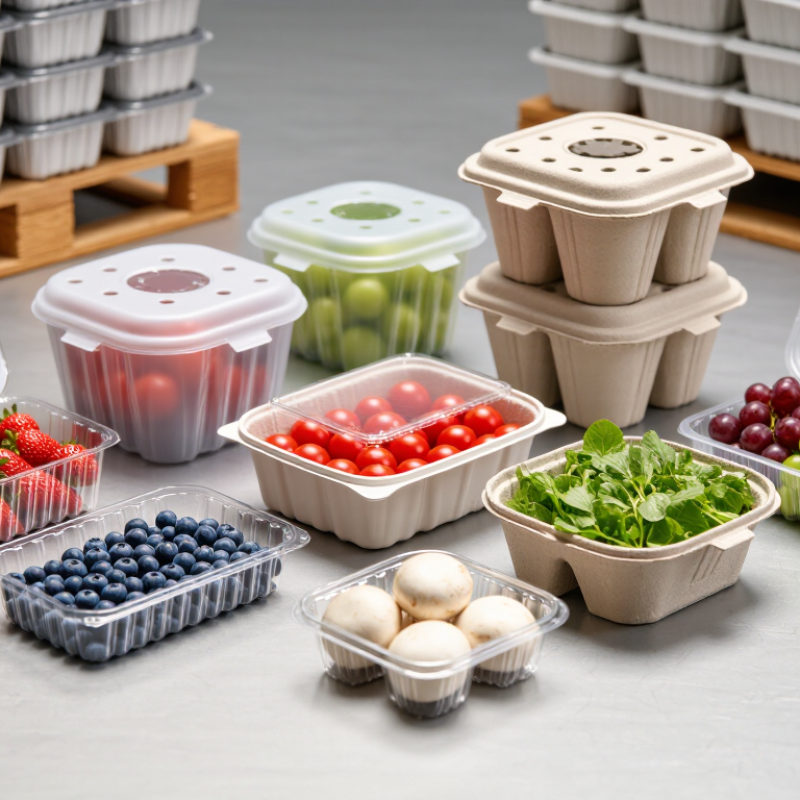
Produce clamshells are rigid, clear containers with hinged lids. They protect berries, grapes, cherry tomatoes, and delicate leafy products during handling. Common formats include vented hinged boxes, stackable trays, and recycled-content plastic versions. Small ventilation holes help release moisture. That detail matters when strawberries travel for days.
The need is measurable. The FAO’s 2019 State of Food and Agriculture report estimated that 14% of food is lost between harvest and retail. The 2024 UNEP Food Waste Index Report recorded 1.05 billion tonnes of food waste in 2022. Clamshells cannot solve that problem alone. However, they can reduce crushing, contamination exposure, and careless handling.
Global buyers also value visibility. A clear lid lets inspectors check color, mold, bruising, and fill level without opening every pack. Standard footprints improve pallet stability and retail display efficiency. Vented designs may support cooling, but excessive openings can weaken protection. This is where specifications need honesty.
Material selection remains complicated. Virgin PET offers consistency, while recycled PET can support circularity goals when supply and local recycling systems are reliable. Those systems differ sharply by market. Buyers should request test data for compression strength, seal or hinge performance, ventilation, and temperature exposure. A low-cost clamshell may become expensive after rejected loads, hidden bruising, or poor shelf presentation.
Which Produce Clamshell Types Are Available in 2026?
In 2026, global buyers can choose from several produce clamshell types, each suited to different crops and transport conditions. Hinged clamshells remain common for berries, cherry tomatoes, and cut fruit. Their attached lids reduce loose components and speed up packing. Two-piece clamshells offer separate bases and lids, which can simplify high-volume filling. They may require better closure control.
Vented clamshells include small openings that release heat and moisture. This design helps strawberries, blueberries, and leafy herbs stay firmer during long shipments. Perforation size matters. Large openings can increase dehydration, while tiny vents may trap condensation. Clear PET and recycled PET options provide strong visibility and stacking performance. PP clamshells offer useful flexibility for heavier produce. Compostable fiber or PLA formats are also available in selected markets, but their heat and moisture resistance can vary considerably.
Buyers should match the package to the crop, route, and storage temperature. A practical trial can compare five filled packs after vibration, chilling, and one day at room temperature. Check cracked hinges, fogging, berry pressure marks, and lid security. Food-contact compliance, recycled-content claims, labeling rules, and recycling access must be verified in the destination market. Certification documents should come from the packaging producer, not only from a trading intermediary. No single format wins every shelf. That assumption can fail. Availability also changes with resin supply, regional regulations, and seasonal production capacity.
How Do Materials and Designs Affect Clamshell Performance?
For global produce buyers, clamshell performance begins with the material. PET offers strong clarity and useful impact resistance for berries and cherry tomatoes. Recycled PET can reduce virgin plastic use, but its quality may vary between suppliers. PP tolerates warmer handling conditions and repeated flexing, although it may look less transparent. Compostable materials sound attractive, yet moisture resistance and industrial processing requirements need careful verification.
Design matters just as much. Tiny ventilation holes can release condensation while limiting dehydration. A secure hinge and locking tab reduce accidental opening during pallet movement. Stackable feet protect delicate fruit from crushing. Rounded corners also help prevent punctures in transport cartons. Small changes matter.
Size must match the produce. A deep container may leave empty space, allowing fruit to shift and bruise. A tight fit can create pressure marks. Clear walls support visual inspection, but excessive clarity can encourage unnecessary packaging weight. That trade-off deserves honest review. Some lightweight designs perform well in controlled tests but fail after rough handling, temperature changes, or repeated stacking. Buyers should request drop, compression, seal, and condensation testing with actual produce. Material selection should also meet destination-market food-contact and recycling requirements. Specifications alone are not enough. Supplier records, test conditions, and production consistency reveal more than attractive samples.
How Should Buyers Compare Size, Ventilation, and Product Protection?
2026 Top Produce Clamshell Types for Global Buyers
When comparing produce clamshells, size should match the product, not just the target shelf image. Small berries need snug cavities that limit movement and bruising. Larger packs suit leafy items, grapes, or mixed produce, but extra space can increase shaking during transport. In packing trials, I have seen attractive oversized packs arrive with crushed corners and loose fruit. That result changed our evaluation method.
Ventilation deserves equal attention. Small vents can reduce condensation, yet excessive openings may cause faster moisture loss. The ideal pattern depends on produce respiration, cooling speed, and transport duration. Clear hinged clamshells offer fast visual inspection, while stackable designs can improve pallet stability. However, “clear” does not always mean better protection. Weak hinges, sharp edges, or thin walls may fail under pressure. Some assumptions need testing.
Tips: Place filled samples in a cold room, then simulate stacking and short-distance handling. Check corner damage, fogging, fruit movement, and lid security. Compare the same produce after 24 hours, not only at packing. Ask suppliers for material thickness, ventilation layout, and drop-test records. Recycled-content options may support sustainability goals, but buyers should verify clarity, strength, and food-contact documentation. No single clamshell type works everywhere. Test before committing.
2026 Top Produce Clamshell Types for Global Buyers
How should buyers compare size, ventilation, and product protection?
Common retail clamshell formats range from 125 g berry packs to 1 kg produce packs. Nominal capacity is shown in grams, while ventilation is the approximate open-area ratio used for airflow planning. The protection score is a buyer comparison index based on rigidity, stack resistance, lid security, and headspace; higher values indicate stronger expected product protection.
What Sustainability and Compliance Factors Guide Global Purchasing?
Global buyers are reassessing clamshell packaging for 2026. Clear rPET containers offer product visibility and measurable recycled content. PP clamshells can provide strength, but recycling access differs by market. Paper-based formats reduce plastic use, yet coatings may complicate recovery. Compostable options sound attractive. They are not always the greener choice.
Sustainability claims need evidence, not attractive wording. Buyers should request recycled-content certificates, food-contact declarations, and supplier traceability records. Packaging must protect berries, salads, and prepared foods during humid transport. A weak hinge or poor seal can increase product waste, offsetting material savings. I have seen specifications focus on package weight while ignoring damaged shipments. That approach needs reconsideration.
Compliance checks should cover chemical migration, labeling, extended producer responsibility fees, and local recycling instructions. Requirements vary between countries and sometimes between regions. Procurement teams should confirm the latest rules before approving artwork or tooling. Independent testing can verify seal strength, recycled content, and material composition. Suppliers should also explain factory audits and corrective-action procedures. No format is perfect. A lighter clamshell may use less material but perform poorly in cold-chain handling. The strongest purchasing decision balances verified sustainability, legal readiness, food protection, and realistic end-of-life conditions.
2026 Top Produce Clamshell Types for Global Buyers - What Sustainability and Compliance Factors Guide Global Purchasing?
Practical comparison of common produce clamshell formats, sustainability considerations and international purchasing checks
| Clamshell type | Typical produce applications | Material and format characteristics | Sustainability considerations | Key compliance factors for global purchasing | Indicative procurement profile | Recommended buyer verification |
|---|---|---|---|---|---|---|
| Clear PET clamshell | Berries, grapes, cherry tomatoes, stone fruit and cut produce | Transparent, rigid and lightweight; commonly made as a hinged container with ventilation openings and a tamper-evident closure | PET is widely recyclable where collection and sorting systems accept PET packaging. Clear, uncoated mono-material designs generally support better sorting than colored, laminated or heavily labeled formats. | Food-contact authorization in the destination market; packaging-waste labeling; extended producer responsibility obligations; restrictions on unnecessary packaging; migration and overall safety documentation | High visibility, good impact resistance and broad converting availability; often selected when product presentation and pack protection are priorities | Confirm resin identification, recycled-content declaration, closure performance, vent design, pack weight, pallet efficiency and compatibility with local recycling guidance |
| rPET clamshell | Berries, grapes, salads, premium fruit and ready-to-eat produce | Rigid transparent PET packaging containing post-consumer recycled PET, subject to the applicable food-contact rules and supply availability | Can reduce reliance on virgin plastic and support circular material demand. Benefits depend on verified recycled content, responsible feedstock sourcing, manufacturing energy and end-of-life collection. | Food-contact approval for recycled plastic; chain-of-custody or recycled-content evidence where required; recycled-content claims; EPR reporting; correct recycling instructions | Usually positioned as a lower-virgin-plastic option; pricing and supply may vary with recycled resin quality and regional demand | Request a material specification, recycled-content percentage by mass, batch traceability, food-contact declaration, contaminant controls and evidence supporting environmental claims |
| PP clamshell | Tomatoes, berries, mushrooms, herbs, salads and prepared produce | Lightweight polypropylene format with good toughness and heat resistance; may be transparent, translucent or opaque | PP recycling is available in some markets but collection and sorting coverage is less consistent than for commonly collected PET in many regions. Mono-material construction improves recyclability potential. | Food-contact compliance; national recycling-label requirements; EPR fees; applicable recycled-content rules; restrictions on additives, inks, coatings and intentionally added substances | Good balance of durability, low weight and design flexibility; suitable where resistance to cracking during transport is important | Check local recycling acceptance before switching from PET; verify hinge fatigue, stacking strength, sealing quality, vent area and temperature limits |
| Molded fiber or paperboard clamshell | Mushrooms, berries, tomatoes, specialty fruit and dry produce | Fiber-based structure formed from molded pulp or folded paperboard; may use a transparent window, barrier coating or separate plastic film | Renewable fiber content can be advantageous, but recyclability depends on coatings, adhesives, wet-strength agents, windows and contamination. Fiber sourcing should be legal and traceable. | Food-contact safety; fiber-source legality and due diligence; recyclability or compostability claim requirements; coating and ink compliance; moisture and odor-transfer testing | Distinctive natural appearance and potential fiber reduction of plastic; usually requires careful moisture management and transport validation | Identify all layers and components; verify whether the package is recyclable or industrially compostable in the target market; test wet strength, shelf life, compression and leakage resistance |
| PLA bioplastic clamshell | Cold produce, berries, salad greens and short-life fresh products | Biobased thermoplastic made from fermented plant-derived feedstocks; typically clear and rigid but sensitive to higher temperatures | Industrial compostability is not the same as home compostability or ordinary biodegradability. PLA can contaminate conventional PET recycling streams if incorrectly sorted. | Food-contact authorization; substantiated compostability claims; conformity with applicable industrial-composting standards; disposal instructions; restrictions on misleading biodegradability claims | Considered where certified composting infrastructure and separate collection are available; generally requires strict temperature and disposal controls | Confirm certification scope, operating temperature, shelf-life performance, composting-site acceptance and clear disposal labeling in every target country |
| Ventilated produce clamshell | Berries, grapes, leafy greens, mushrooms and moisture-sensitive produce | A functional design category available in PET, rPET, PP, fiber or hybrid structures; vent geometry controls airflow and moisture release | Correct ventilation may reduce condensation, mold risk and food loss. The sustainability benefit should be assessed together with material weight, product protection and actual shelf-life results. | Food-contact safety; performance testing for the intended produce; labeling and traceability; packaging-waste obligations; no unsupported food-waste reduction claims | Selected primarily for freshness and quality retention; design must be matched to produce respiration rate, cold-chain conditions and distribution duration | Validate vent area, condensation control, product temperature, shelf life, transport vibration and pack strength under realistic cold-chain conditions |
| Tamper-evident clamshell | Premium berries, cut fruit, ready-to-eat salads and high-value specialty produce | Hinged or two-piece structure with an integrated breakable seal, tear strip or locking feature; produced in several rigid materials | Integrated mono-material seals are generally preferable to separate stickers, metalized films or incompatible components. Added security should be balanced against extra material use. | Food-contact compliance; tamper-evidence performance; traceability and lot coding; allergen and ready-to-eat hygiene controls where relevant; recycling instructions | Improves visible package integrity and retail handling control; may increase tooling complexity and unit cost | Test seal activation, evidence of opening, child-safety considerations where applicable, closure repeatability, label adhesion and recyclability after opening |
