
2026 Top Sheet Extruder Types for Global Buyers?
Choosing the right Sheet Extruder in 2026 requires more than comparing output rates and purchase prices. Global buyers now assess material flexibility, energy use, automation, recycled-content capability, and after-sales support. The machine must perform reliably beside real production constraints: fluctuating resin quality, humid storage rooms, narrow factory aisles, and demanding delivery schedules.
Industry data supports this broader view. PlasticsEurope reported global plastics production of approximately 414 million tonnes in 2023, confirming the scale of demand for efficient processing equipment. Grand View Research has also identified steady growth in plastic extrusion machinery, driven by packaging, construction, automotive, and medical applications. Meanwhile, the OECD and other sustainability-focused reports continue to highlight rising pressure for resource efficiency and improved plastic circularity. These trends are reshaping buyer priorities.
This guide compares major Sheet Extruder types, including single-screw, twin-screw, co-extrusion, cast-sheet, and recycled-material systems. Each design has practical strengths. Single-screw machines often offer simpler operation. Twin-screw systems can improve mixing. Co-extrusion lines support multilayer structures and functional surfaces. However, no machine wins in every factory.
That matters.
A low-cost line may consume more energy or require frequent manual adjustment. A highly automated system may exceed the needs of a small converter. Buyers should examine melt uniformity, die performance, thickness control, cooling capacity, installation support, and spare-part availability. Some published market forecasts use different definitions, so their figures should not be treated as absolute. Careful verification remains necessary before signing a global equipment contract.
What Is a Sheet Extruder and How Does It Work?
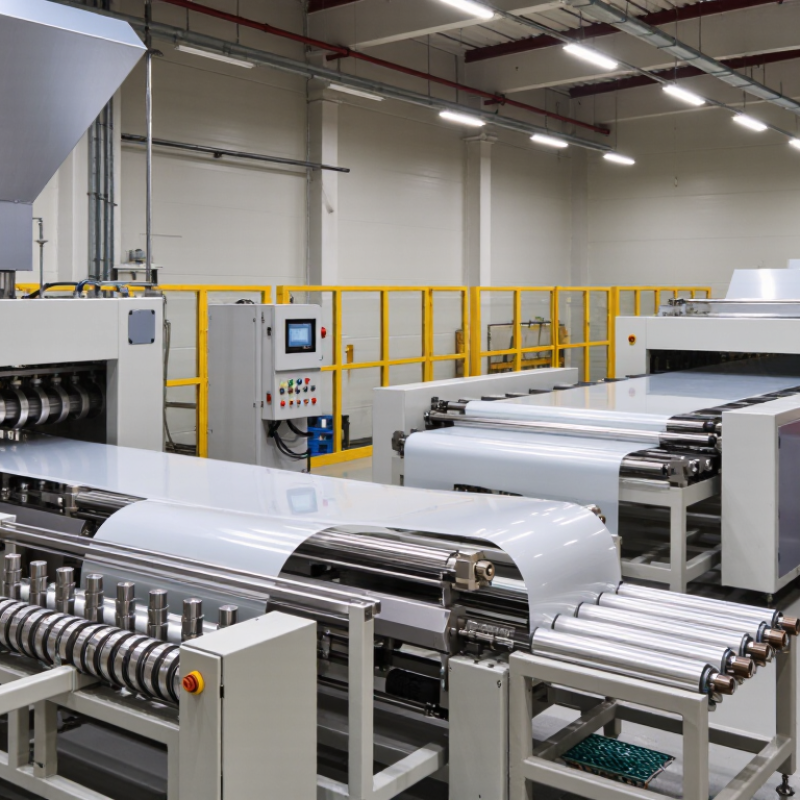
A sheet extruder converts plastic pellets into a continuous, flat sheet. The process starts when pellets enter a heated barrel through a feed hopper. A rotating screw moves and compresses them. Heat and friction gradually create a uniform melt. The screw must maintain steady pressure, or the sheet may show lines, bubbles, or uneven thickness.
At the screw tip, the molten material passes through a flat die. The die spreads the melt across the required width. Polishing rolls then shape and cool the sheet. Their temperature, speed, and gap strongly affect the final surface. Cooling is practical, but not always simple. Excessive cooling can create internal stress. Insufficient cooling may cause warping during stacking.
Common sheet extruder types include single-screw, twin-screw, and co-extrusion systems. Single-screw machines suit many standard thermoplastic sheets and usually offer simpler operation. Twin-screw systems provide stronger mixing for filled or blended materials. Co-extrusion lines combine different layers, such as a functional surface and a structural core. Global buyers should inspect screw design, die control, roll temperature control, and thickness measurement. Ask for production samples, not only output figures. A machine rated for high capacity may perform poorly with unstable raw materials. Moisture control, filtration, and operator training also influence reliability. A perfect first setup is unlikely. Trial data often reveals more than a polished brochure.
Key Sheet Extruder Types Available to Global Buyers in 2026
In 2026, global buyers can choose several sheet extruder types, each suited to different production goals. Single-screw extruders remain practical for stable materials and straightforward sheet production. They offer simpler operation, easier maintenance, and predictable energy use. Twin-screw extruders provide stronger mixing for filled, recycled, or temperature-sensitive compounds. Their higher cost may be difficult to justify for uniform materials.
Co-extrusion systems produce multilayer sheets with separate functional surfaces. One layer can improve appearance, while another supports strength, barrier performance, or impact resistance. Cast sheet lines use a flat die and cooling rolls to create smooth, consistent surfaces. They are useful when thickness control and optical quality matter. Some buyers also compare extrusion-calendering layouts, although these systems require different process knowledge and maintenance planning.
An experienced purchasing team should review output rate, screw design, die width, cooling capacity, and changeover time. Material trials are essential, especially when using recycled feedstock or mineral-filled compounds. Ask for documented test results, safety records, spare-parts availability, and operator training. Check actual sheet samples, not only machine specifications. A low purchase price can hide higher energy use or unstable thickness. This happens more often than expected. Buyers should also confirm electrical requirements, installation support, and applicable regional standards before signing a contract. No checklist replaces a production trial, and even a well-designed line may need adjustments after installation.
How Different Extruder Designs Compare in Performance and Output
For global buyers, sheet extruder design should match material, thickness, and target output.
PlasticsEurope reported 413.8 million tonnes of global plastics production in 2023. That scale increases pressure on stable, energy-aware processing.
Single-screw extruders often suit uniform polymers and steady sheet production. Their simpler layout can reduce maintenance points and operator training. A well-designed barrier screw may improve melting and reduce unmelted particles.
Twin-screw systems offer stronger mixing for fillers, additives, and recycled feedstock. They also provide better process flexibility, but torque demand and equipment cost can rise. Output is not everything.
Coextrusion lines produce multilayer sheets with barrier, recycled, or impact-resistant layers. This design can lower expensive resin use, yet layer balance becomes sensitive to melt temperature and die pressure.
OECD’s Global Plastics Outlook states that only 9% of plastic waste was recycled globally in 2019. That figure supports equipment capable of handling variable recycled inputs, but no extruder removes contamination by itself.
In plant trials, buyers should compare kilograms per hour, thickness variation, melt stability, and scrap rate. A quoted maximum output may use ideal resin and laboratory conditions. Real production is less tidy.
The best selection may be a slightly slower line with consistent 2-millimeter sheet, fewer edge trims, and easier cleaning.
Which Sheet Extruder Features Suit Different Production Needs?
Sheet extruder features should match the material, output target, and operator skill available at each plant. For rigid packaging sheets, a stable single-screw extruder may provide steady output and simpler maintenance. Recycled or blended materials often need twin-screw mixing, stronger filtration, and accurate melt-temperature control. In production trials, I watch pressure changes near the die. Small fluctuations can create visible thickness bands.
For high-volume lines, buyers should examine screw diameter, motor efficiency, automatic thickness control, and cooling-roll capacity. A wider die supports larger sheets, but it also demands better edge control. Fast roll adjustment helps when switching between thin trays and thicker construction panels. It sounds minor. It is not. Operators lose material when controls respond slowly.
Sensitive polymers may require low-shear screws, precise barrel zones, and a closed-loop feeder. Transparent sheets need clean filtration and polished flow channels, while textured sheets may tolerate less demanding surfaces. Ask for measured output data, sample sheets, maintenance records, and electrical documentation. A serious supplier should explain testing conditions instead of presenting one impressive number. I would also leave room for doubt: laboratory results rarely match dusty floors, changing humidity, or inexperienced shifts. Features that look excessive on paper can become practical insurance during a difficult production week.
| Priority | Sheet Extruder Type | Typical Screw or Layer Configuration | Common Throughput Range | Best-Suited Materials | Typical Sheet Applications | Key Features to Specify | Main Advantages | Important Purchasing Considerations | |
|---|---|---|---|---|---|---|---|---|---|
| 1 | General-Purpose Single-Screw Extruder | 45–150 mm screw diameter; L/D commonly 28:1–36:1 | Approximately 80–700 kg/h | PP, PE, PS, ABS and other standard thermoplastics | Packaging sheets, stationery sheets, thermoforming sheets and construction panels | Stable melt-pressure control, automatic thickness adjustment, efficient barrel heating and a suitable screen changer | Simple operation, lower maintenance requirements and broad material compatibility | Confirm screw design, die width, cooling-roll capacity and expected recycled-content percentage before selection | Best for standard production |
| 2 | Co-Rotating Twin-Screw Extruder | 40–110 mm screw diameter; modular conveying and kneading elements | Approximately 100–600 kg/h | Filled PP, flame-retardant compounds, mineral-filled polymers, recycled blends and color-compounded materials | Technical sheets, automotive panels, building sheets and sheets requiring additives | High mixing capability, gravimetric feeding, vacuum venting and modular screw configuration | Consistent dispersion of fillers and additives with strong formulation flexibility | Usually has higher capital cost and energy demand than a basic single-screw line; verify residence time and cleaning procedures | Best for compounding |
| 3 | Counter-Rotating Twin-Screw PVC Extruder | Parallel or conical twin-screw design; commonly configured for rigid or foamed PVC | Approximately 80–500 kg/h | Rigid PVC, foamed PVC and PVC formulations containing stabilizers, impact modifiers or mineral fillers | Window and door panels, wall cladding, furniture boards and decorative PVC sheets | Accurate temperature control, low-shear melting, corrosion-resistant material-contact surfaces and dedicated PVC screw geometry | Good PVC processing stability and controlled melt temperature | Check formulation compatibility, degassing performance, die design and protection against thermal degradation | Best for PVC sheet |
| 4 | PET Sheet Extrusion Line | Dedicated single-screw or twin-screw system with crystallization and dehumidifying preparation | Approximately 250–1,500 kg/h | APET, RPET, PETG and PET blends, depending on the line design | Food packaging, blister packaging, medical packaging and thermoforming sheet | Low-dew-point drying, crystallizer, melt filtration, vacuum venting and precise melt-temperature control | Supports high clarity and stable intrinsic-viscosity control when drying is correctly managed | PET is moisture-sensitive; specify drying capacity, residence time, filtration level and food-contact compliance where required | Best for PET packaging |
| 5 | Multilayer Co-Extrusion Line | Two to seven or more extruders feeding a multilayer feedblock and flat die | Approximately 150–2,000 kg/h | PE, PP, PET, EVOH, PA, adhesive polymers and other compatible layer combinations | Barrier packaging sheet, impact-resistant panels, weatherable sheets and functional laminated structures | Independent extruder control, feedblock accuracy, layer-ratio control, melt-pressure monitoring and automatic die adjustment | Combines different material properties while reducing the amount of expensive or functional resin used | Material compatibility, layer adhesion, startup waste, changeover time and feedblock cleaning are critical evaluation points | Best for functional layers |
| 6 | Optical-Grade Sheet Extruder | Precision single-screw or twin-screw system with ultra-clean melt handling | Approximately 150–1,000 kg/h | PC, PMMA, PETG and other optical or high-clarity thermoplastics | Lighting diffusers, display components, transparent covers and high-clarity protective sheets | Low-pulsation melt delivery, high-efficiency filtration, clean-room-compatible components, precise roll temperature control and low-scratch handling | Improves clarity, thickness uniformity and surface quality | Require strict control of contamination, moisture, die lines, roll marks and material residence time | Best for high clarity |
| 7 | Recycled-Material Sheet Extruder | Single-screw or twin-screw system with forced feeding, degassing and high-performance filtration | Approximately 100–1,200 kg/h | Recycled PP, PE, PET, ABS and production scrap, subject to contamination and moisture limits | Transport packaging, pallets, protective boards, construction sheets and non-critical thermoformed products | Vacuum degassing, melt filtration, metal detection, automatic backflush screen changer and adaptive temperature control | Handles variable feedstock quality and supports higher recycled content | Define allowable contamination, moisture level, melt-flow variation, odor requirements and filtration fineness | Best for recycled feedstock |
| 8 | Foam Sheet Extruder | Single-screw or tandem configuration with physical or chemical foaming system | Approximately 100–800 kg/h | PE, PP, PS, PVC and selected engineering polymers designed for foaming | Insulation boards, protective packaging, lightweight panels and cushioning sheets | Accurate gas or chemical-agent dosing, high-pressure melt control, nucleating-agent dispersion and calibrated cooling | Reduces density and material consumption while providing cushioning or insulation properties | Evaluate cell-size uniformity, density range, ventilation requirements, fire performance and downstream trimming capability | Best for lightweight sheets |
| 9 | High-Temperature Engineering-Plastic Sheet Extruder | Specialized single-screw or twin-screw system with high-temperature barrel, die and thermal-control package | Approximately 50–500 kg/h | PA, PEEK, PPS, PEI, PSU, PVDF and other high-temperature polymers, depending on equipment design | Electrical insulation, aerospace components, chemical-resistant panels and high-performance industrial parts | High-temperature control, corrosion-resistant components, heated feed throat, low-residence-time flow path and robust melt-pressure monitoring | Processes materials requiring elevated melting and processing temperatures | Verify maximum operating temperature, thermal uniformity, material drying, die metallurgy and operator safety systems | Best for engineering polymers |
| Selection note: Throughput figures are typical planning ranges for commercial sheet lines rather than guaranteed outputs. Buyers should compare the same resin grade, sheet width, thickness, moisture level, recycled-content ratio, filtration specification and cooling configuration when requesting quotations. | |||||||||
How to Select a Reliable Sheet Extruder for Global Manufacturing
Global buyers should evaluate a sheet extruder beyond headline output. Plastics Europe reported 413.8 million tonnes of global plastics production in 2023. This scale increases pressure on stable, efficient sheet manufacturing. Check the extruder’s output consistency, melt filtration, screw design, and cooling-roll control. A practical factory test should measure thickness across the sheet width, not only average thickness. Small variations can create serious forming and trimming losses.
Energy consumption also deserves attention. Ask suppliers for measured kilowatt-hours per kilogram under comparable materials and output rates. The OECD’s Global Plastics Outlook projects plastic waste could nearly triple by 2060 without stronger controls. Therefore, select equipment that processes approved recycled feedstock without unstable pressure or frequent screen changes. Compatibility matters. A machine designed for one resin may perform poorly with another. That detail is often overlooked.
Tips: Request a material trial using your actual resin blend. Inspect the control cabinet, heating zones, and spare-parts list. Confirm local service response times and operator training. A clear acceptance test should define thickness tolerance, output, energy use, and startup time. Do not trust brochure figures alone. My own selection rule is simple: reliability must be proven under production conditions. Still, even a well-tested extruder can disappoint when feeding systems, cooling water, or maintenance routines are weak. That uncomfortable point deserves attention.
2026 Top Sheet Extruder Types for Global Buyers
Indicative typical output capacity by sheet extruder type
Twin-screw systems generally provide stronger mixing and material flexibility, while single-screw extruders are often preferred for stable, cost-efficient production of common thermoplastics. Co-extrusion lines can deliver higher combined throughput and multilayer structures, but they require more complex dosing, temperature control, and maintenance. Actual capacity depends on polymer type, sheet width, thickness, moisture level, die design, and cooling performance.
