
Request A Quote

Phone: 416-244-6476
Email:

    What Is Aluminum Extrusion and How Is It Used?

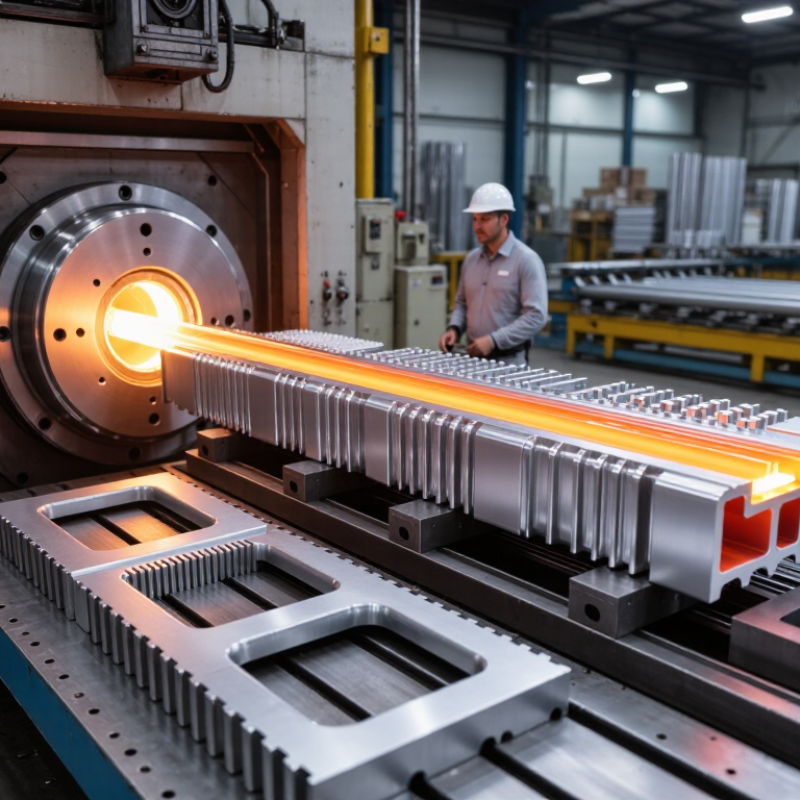
    What is Aluminum Extrusion, and why does it matter in modern manufacturing? Aluminum Extrusion is a forming process that pushes a heated aluminum billet through a shaped steel die. The emerging profile matches the die’s opening. It may resemble a simple metal strip, but the process demands careful control. Temperature, pressure, alloy selection, and cooling speed all affect the final result. The profile can include channels, ribs, grooves, or hollow sections. These details reduce assembly steps and improve functional performance.

    In practical manufacturing, engineers use alloys such as 6061 and 6063 for different requirements. Alloy 6063 often supports smooth surfaces and architectural finishes. Alloy 6061 generally offers higher strength for structural or mechanical components. After extrusion, profiles may be cut, aged, anodized, painted, or machined. A window frame, LED heat sink, conveyor rail, and vehicle component may begin as one continuous extrusion. That flexibility explains its broad industrial use.

    The process sounds simple. It is not always predictable. Die wear, uneven cooling, and minor dimensional changes can affect fit and appearance. Experienced producers inspect profiles with gauges, measuring equipment, and documented quality procedures. They also review tolerances before production begins, rather than correcting problems later. Industry standards and verified material certificates help improve traceability. Still, design decisions require judgment. A lightweight profile may save material, yet it could need thicker walls or internal supports. Understanding these trade-offs helps designers choose Aluminum Extrusion with greater confidence and fewer costly revisions.
    What Is Aluminum Extrusion and How Is It Used?

    What Is Aluminum Extrusion?

    Aluminum extrusion is a manufacturing process that shapes aluminum into a continuous profile. A heated billet is pressed through a steel die with a carefully designed opening. The metal becomes the required cross-section as it leaves the die. It is softened, not melted. Think of firm clay passing through a shaped nozzle. The emerging profile may be cut into precise lengths, then cooled and straightened.

    The die can create simple bars, complex channels, or hollow sections. Hollow profiles require specialized tooling and controlled metal flow. Extruded aluminum appears in window frames, machine guards, heat sinks, transport components, and modular structures. Its low weight and corrosion resistance make it useful in many industries. However, the extrusion direction can influence strength and surface appearance.

    Good results depend on more than a clever shape. Engineers review the alloy, wall thickness, corner radius, die design, and required tolerances. Thin walls may cool unevenly. Uneven flow can create twisting, surface lines, or dimensional variation. A first design may look correct on screen and still fail during production. That is a useful warning. Experienced manufacturers inspect dimensions, hardness, straightness, and surface quality after extrusion. Cutting, drilling, machining, or finishing may follow, depending on the application. A drawing alone is rarely enough; practical testing often reveals what the design missed.

    How the Aluminum Extrusion Process Works

    Aluminum extrusion begins with a cylindrical billet, usually heated between 400°C and 500°C. The softened metal enters a steel die under heavy hydraulic pressure. The die controls the profile, whether it becomes a window frame, heat sink, rail, or structural channel.

    In direct extrusion, the ram pushes the billet through the die. The emerging section moves continuously along a runout table. Operators then cool, stretch, cut, and sometimes age the profiles for higher strength. Small temperature changes matter. Uneven cooling can create twisting, surface marks, or dimensional drift.

    The process is material-efficient because one die can produce long, precise sections with limited machining. The International Aluminium Institute reports that recycling aluminium requires about 5% of the energy used for primary production. That figure makes scrap recovery important around extrusion presses. Clean offcuts can return to the material cycle, although coatings and mixed alloys complicate sorting.

    Quality control usually includes hardness checks, dimensional measurement, and visual inspection under strong lighting. Experienced technicians watch the exit speed and surface texture closely. A profile can look acceptable and still fail a tight tolerance later. That is where process records help. They connect billet temperature, press speed, die condition, and final performance. The method is efficient, but it is not flawless. Poor die design still wastes metal, time, and energy. (International Aluminium Institute, Aluminium Sector Greenhouse Gas Pathways to 2050; International Aluminium Institute, Aluminium Recycling Facts)

    Typical Temperature Ranges in the Aluminum Extrusion Process

    Aluminum extrusion heats a billet and pushes it through a shaped die to create a continuous profile. The temperatures shown are representative ranges commonly used for aluminum alloys; actual settings vary with alloy, billet size, die design, and extrusion speed.

    Common Types of Aluminum Extrusion

    Aluminum extrusion shapes heated billets by pushing them through a designed die. The method produces long profiles with consistent cross-sections. Common uses include window frames, machine guards, heat sinks, rails, and lightweight structural supports. The right profile depends on load, airflow, appearance, and finishing requirements.

    Solid extrusion creates a fully filled shape, such as a flat bar, angle, or channel. It suits frames, brackets, and support rails. Hollow extrusion forms enclosed spaces, including tubes and box sections. These profiles can improve stiffness while reducing material weight. Semi-hollow extrusion has a narrow opening and supports more complex shapes. It is useful for handles, tracks, and parts requiring internal strength. Custom extrusion combines several features in one profile. However, tighter shapes usually require more careful die design, cooling control, and dimensional inspection.

    Tips: Confirm wall thickness before production. Very thin sections may cool unevenly or twist. Check corner radii, because sharp internal corners can weaken the profile and raise tooling difficulty. Ask for samples when appearance matters. A polished drawing can still miss assembly problems. In practice, small changes to slot width or screw access often save time later. That lesson is easy to overlook. Specify alloy, temper, length tolerance, and surface finish clearly. Also review how the profile will be cut, drilled, joined, and transported. An extrusion that looks efficient on paper may become awkward during installation.

    What Is Aluminum Extrusion and How Is It Used? - Common Types of Aluminum Extrusion
    Extrusion Type Cross-Section Characteristics Typical Production Method Common Applications Main Advantages Important Considerations
    Solid Extrusion Contains no enclosed internal cavities; examples include flat bars, round bars, angles, channels, and square bars. Heated aluminum billet is pushed through a die with an open profile. Frames, rails, heat sinks, brackets, machine components, and structural supports. Generally easier to produce, machine, join, and finish than hollow profiles. Uses more material than a comparable hollow profile when the design does not require a solid section.
    Hollow Extrusion Includes one or more fully enclosed internal cavities, such as tubes and box sections. Produced with a porthole or bridge die; the aluminum is divided around the die bridges and rejoined under pressure. Window and door frames, tubes, vehicle components, piping, and lightweight structural members. Provides high stiffness relative to weight and can integrate multiple functional features. Die design is more complex, and the extrusion may contain longitudinal weld lines formed during production.
    Semi-Hollow Extrusion Has a partially enclosed cavity with a narrow opening or an opening smaller than the surrounding profile width. Uses a specialized die that forms a near-enclosed section while maintaining sufficient metal flow around the die. Sliding tracks, handles, channels, housings, and custom mechanical profiles. Offers some weight reduction and functional geometry without the full complexity of a completely closed hollow section. Requires careful control of wall thickness, die strength, and metal flow.
    Custom Profile Designed for a specific cross-section, often combining ribs, grooves, holes, flanges, and mounting features. A dedicated die is designed according to the required geometry, tolerances, alloy, and production volume. Solar-panel mounting systems, automation equipment, electronic enclosures, furniture, and specialized transport parts. Can reduce the number of separate parts, assembly steps, and secondary machining operations. Initial die costs and design time are higher than for standard profiles.
    Structural Extrusion Uses profiles engineered to carry loads, including I-sections, T-sections, channels, angles, and reinforced hollow shapes. Profile geometry is optimized for bending, compression, torsion, or connection requirements. Machine frames, guardrails, platforms, construction systems, and lightweight structural assemblies. Combines low density with useful strength and can simplify modular construction. Load capacity depends on alloy, temper, wall thickness, unsupported length, connections, and applied loads.
    Heat-Sink Extrusion Features a base with multiple fins that increase the surface area available for heat transfer. Usually made as a solid profile with thin, closely spaced fins formed directly by the die. LED lighting, power electronics, control equipment, telecommunications hardware, and industrial electronics. Provides passive cooling without fans or pumps and can be cut to different lengths. Thermal performance depends on fin geometry, airflow, orientation, contact resistance, and surface area.
    Direct Extrusion The billet and ram move in the same direction while the metal flows through a stationary die. The most common process arrangement for many aluminum profiles; friction occurs between the billet and container wall. General-purpose solid, hollow, semi-hollow, and custom profiles. Suitable for a broad range of shapes, alloys, and production requirements. Friction can increase the required force and contribute to temperature variation during extrusion.
    Indirect Extrusion The die moves toward the stationary billet, so the metal flows in the opposite direction to the die movement. A hollow ram forces the die through the billet, reducing relative motion between the billet and container. Selected profiles requiring improved dimensional consistency or reduced friction effects. Can reduce friction and extrusion force while producing more uniform metal flow. Equipment and tooling are more specialized, and profile size may be limited by press design.
    Common Alloy Families Extrusion alloys are selected for a balance of formability, strength, corrosion resistance, machinability, and finishability. Common choices include 6xxx-series alloys for general profiles and 1xxx-, 3xxx-, and selected 5xxx-series alloys for specific requirements. Building products, transportation parts, heat sinks, consumer products, and industrial equipment. Aluminum offers low density, natural corrosion resistance, electrical and thermal conductivity, and recyclability. Alloy and temper must be matched to the required strength, surface finish, bendability, weldability, and operating environment.
    Typical Post-Extrusion Operations Profiles may be cut, straightened, machined, drilled, bent, joined, heat-treated, or surface-finished. Operations are selected after extrusion to achieve final dimensions, mechanical properties, appearance, or assembly features. Precision components, architectural products, frames, enclosures, and finished consumer goods. Extends the usefulness of an extruded profile and can reduce the need for multiple fabricated parts. Additional operations increase processing time and cost; dimensional changes from heat treatment or finishing must be considered.

    Materials, Tools, and Design Considerations

    What Is Aluminum Extrusion and How Is It Used?

    Materials, Tools, and Design Considerations

    Aluminum extrusion shapes heated billet through a steel die, producing long profiles with consistent cross-sections. Common alloys balance strength, corrosion resistance, weight, and machinability. Some profiles suit lightweight frames, while others support heavier platforms or machine guards. Temper also matters because heat treatment changes hardness and load performance. A millimeter can matter.

    Typical tools include a cutting saw, drilling machine, tapping tools, deburring equipment, and precision measuring instruments. A clean cut reduces assembly gaps and prevents sharp edges. Calipers can check dimensions, but critical parts may need coordinate measurement. In practical fabrication, chips often hide inside slots, causing poor fastener seating. Cleaning is not optional. Surface treatments can improve appearance and durability, yet they do not repair weak design or incorrect alloy selection.

    Designers should consider load direction, wall thickness, corner radii, fastening access, and thermal expansion. Thin walls save material but may twist during machining or assembly. Rounded corners usually improve strength and help metal flow through the die. Slots can simplify adjustment, although they may reduce stiffness around heavily loaded joints. Engineers should show tolerances clearly on drawings and verify them with samples. A useful design is not always the most compact one. I have seen efficient-looking profiles become difficult to cut, clean, and assemble. That oversight deserves more attention. Corrosion can also occur where aluminum contacts incompatible metals, so insulating washers or suitable coatings may be necessary.

    Industrial and Everyday Applications of Aluminum Extrusions

    What Is Aluminum Extrusion and How Is It Used?

    Aluminum extrusion begins by pressing heated aluminum through a shaped opening, called a die. The process creates long profiles with consistent dimensions and useful internal channels. These profiles can be cut, drilled, bent, or joined for specific projects. Their low weight and good strength make them practical for demanding structures.

    In industrial settings, extrusions form machine frames, conveyor supports, guardrails, heat sinks, and solar panel structures. Engineers choose profiles according to load, span, connection method, and operating temperature. A workshop may assemble a frame with simple brackets instead of welding every joint. This saves time and allows later adjustments. However, fast assembly does not replace accurate load calculations.

    Everyday applications are easier to overlook. Aluminum extrusion appears in window frames, shower rails, cabinet handles, lighting tracks, bicycle components, and furniture supports. Its corrosion resistance suits humid rooms, while its clean surface fits modern interiors. Some profiles hide electrical wires inside narrow channels. Others guide sliding doors or protect exposed edges.

    A common workshop lesson is that “lightweight” does not mean “unbreakable.”

    A thin profile may twist when its span becomes too long. Surface scratches can also weaken appearance, even when performance remains acceptable. Careful drawings, proper fasteners, and realistic testing prevent many avoidable problems. Designers still need to question whether a profile is truly suitable for its environment.