Who Are the Best Arc Floor Lamp Suppliers in China?
Choosing the right Chinese supplier for Arc Floor Lamps involves more than comparing catalog prices. Buyers need to examine design capability, material consistency, quality controls, and communication before placing an order. The International Energy Agency has reported that lighting accounts for roughly 15% of global electricity use. That figure concerns lighting broadly, not arc floor lamps alone, but it highlights why efficient light sources and thoughtful product design matter.
Lighting researcher Mariana Figueiro has described light as “the most powerful synchronizer of the human circadian system.” Her work is a useful reminder that a floor lamp is not merely a sculptural object; its light quality and intended use matter, too. For buyers, practical checks include inspecting the lamp’s reach beside a sofa, reviewing finish samples under real room lighting, and confirming how the supplier handles packaging and product testing. Small details count.
This guide compares Chinese suppliers through product range, manufacturing experience, customization options, and evidence of quality processes. Industry reports offer useful context, but they rarely rank suppliers of this specific product category. Supplier claims also deserve careful verification; a polished website is not proof of consistent production. The shortlist can help narrow the search, though no list replaces sample approval and direct due diligence. Some information may remain incomplete, and that is worth acknowledging before a purchase decision.
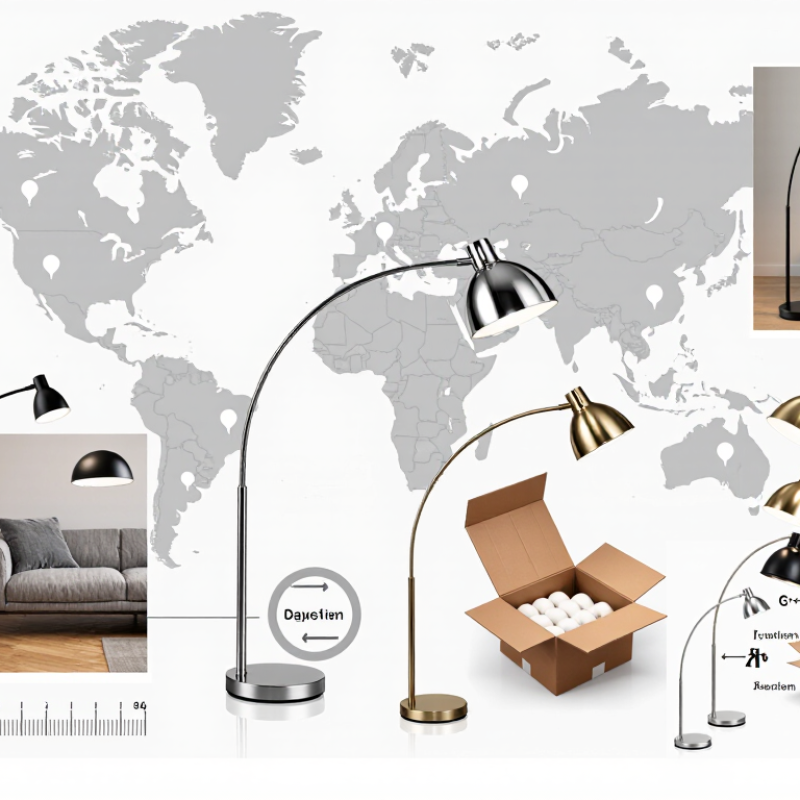
What Defines a Leading Arc Floor Lamp Supplier in China?
A leading arc floor lamp supplier in China proves its capability through repeatable engineering, not catalog photography. For a curved steel arm, weighted base, and fabric shade, ask for material specifications, finish samples, and photometric test files. The U.S. Department of Energy reports that LEDs use at least 75% less energy and last up to 25 times longer than incandescent lighting. That advantage depends on component quality. A supplier should identify the LED module and driver, explain thermal testing, and state the conditions behind its performance claims. Ask for the actual test report.
Production control matters just as much. Check whether the approved sample matches mass-production parts, including welds, cord routing, shade seams, and base stability. Request inspection records and a packaging test for the finished lamp. Samples can mislead. Even experienced buyers sometimes focus on appearance and miss driver temperature or carton damage risks. A dependable supplier will discuss those trade-offs openly, share corrective actions, and provide clear lead times rather than promise perfection. Compare the same specifications across suppliers; otherwise, a lower quote may simply leave out testing, sturdier materials, or safer packaging.
How China’s Arc Floor Lamp Supplier Market Is Organized
China’s arc floor lamp market is organized around specialized production, not a single type of supplier. One factory may bend steel tubes and weld frames, while another focuses on shades, electrical parts, or surface finishes. Some suppliers assemble the complete lamp; others coordinate several workshops. Details matter.
Trading companies can help overseas buyers compare options and manage communication, but they may not own production lines. Direct manufacturers can offer closer control over samples and changes, though their export support varies. A supplier’s role should be confirmed with practical questions: Who makes the frame? Who checks wiring? Can the sample match the approved drawing? Clear answers are more useful than a broad product catalogue.
The market also depends on local networks of metalworking, coating, packaging, and logistics businesses. This can make custom sizing or finishes feasible, but coordination adds risk. A heavy base, for example, needs stable construction and careful packing to avoid damage in transit. A polished sample is not proof of consistent production. I would check a pre-production sample and inspection records, while remembering that paperwork can miss defects too. That assumption can be wrong. Some capable suppliers simply document less, so direct verification matters.
Which Criteria Help Compare Potential Suppliers?
When comparing arc floor lamp suppliers in China, look beyond catalog photos. Request specifications for arm reach, base diameter, shade size, cord length, socket type, wattage, and finish. A long arm shifts the lamp’s balance. Ask for a stability test with the shade and arm fully extended, not just a base-weight figure. Check safety evidence against IEC 60598-1 and IEC 60598-2-4, and confirm it covers the exact model. The International Energy Agency’s Energy Efficiency 2023 report notes that lighting accounts for about 15% of global electricity use. Compare measured power and lumen output; “energy-saving” alone proves little.
Assess production consistency through sample-to-bulk tolerances, material checks, weld quality, coating inspection, and packaging tests. Ask for a recent inspection report and dated production photos. Certificates matter, but they cannot show whether routine quality checks happen on the line. Put defect definitions, replacement terms, minimum order quantities, tooling fees, and lead-time assumptions in writing. Keep an approved sample and compare its finish in daylight and warm indoor light. It sounds fussy. It can prevent disputes. Ask for carton dimensions and packed weight before freight is quoted. One useful question: how does the supplier handle an arm bent during transit? A confident answer is helpful, but it is not proof; verify the process with records.
How to Verify Supplier Quality, Compliance, and Production Capacity
For arc floor lamps, verify the factory, not just its catalog. Ask for a current ISO 9001 certificate and confirm its scope, production site, and issuing body. ISO’s 2022 Survey recorded about 1.26 million valid ISO 9001 certificates across 189 economies. Still, certification alone does not prove a lamp is safe or consistently made. Request inspection records against applicable IEC 60598 requirements, plus calibration records for testing equipment.
Test a production sample for stability, insulation, switch endurance, and heat around the socket. Check the base weight and arm-joint torque; a polished finish can hide weak hardware. I would not rely on one showroom sample. It may be hand-finished. Ask for samples taken from a normal production run, and compare their wiring, coating, and dimensions with the approved specification.
Capacity claims need evidence too. Request monthly output records, shift schedules, peak-season lead times, and recent defect rates. A video of a busy line is not enough. Ask the supplier to trace a lamp’s components back to purchase and inspection records, then review a pilot order before committing to volume. Some factories may hesitate to share exact figures; that is worth discussing, not ignoring. A clear capacity plan should show how extra orders affect lead time and inspection frequency.
How to Select and Work With a Chinese Arc Floor Lamp Supplier
When selecting a Chinese arc floor lamp supplier, look beyond catalog photos and unit price. Share a clear product brief with dimensions, materials, finish, and target market. Specify the lamp’s height, arm reach, base weight, shade size, and cable length. A sketch with measurements can prevent costly misunderstandings. Details matter.
Ask whether the supplier can make a sample and explain its production process. Check welds, shade alignment, surface finish, and whether the lamp stays stable when its arm moves. Request recent production photos and a written quality-check plan. A sample may look excellent, yet the bulk order can vary. Inspecting a production unit, or arranging an independent inspection, can reduce that risk.
Agree on a named contact, response times, and dates for sampling, production, and shipment. Ask the supplier to confirm any design changes in writing, including revised drawings or specifications. Clarify carton dimensions and protective packaging; an arc lamp’s long arm can be damaged in transit. Compare quotations line by line, not just by total cost. If answers remain vague, pause before paying a deposit. I once underestimated how much a small finish difference mattered under warm indoor lighting, so approve the sample under conditions close to actual use.
