
Request A Quote

Phone: 416-244-6476
Email:

    China Best Laminated Wood Veneer Panels Supplier?

    Finding the China best supplier for Laminated Wood Veneer Panels requires more than comparing prices. A reliable evaluation should examine veneer quality, adhesive performance, panel stability, and production consistency. These details become visible in real applications: clean edge lines, even grain, tight joints, and surfaces that remain calm under changing humidity.

    Architect and mass-timber advocate Michael Green has said, “Wood is the only structural material that grows.” His observation explains why responsible sourcing matters. A supplier must show where its wood comes from, how veneers are dried, and which standards guide manufacturing. Certifications, test reports, and traceable batch records provide stronger evidence than attractive brochures.

    Experience also matters. Ask whether the manufacturer has produced panels for hotel walls, office interiors, furniture, or acoustic spaces. Request samples with different veneer cuts and finishes. Check the backer, core construction, thickness tolerance, fire performance, and formaldehyde documentation. Small differences can affect installation time and long-term appearance.

    The best supplier may not be the cheapest. It should communicate clearly, answer technical questions, and manage custom sizes without creating confusion. Still, no supplier is perfect. Sample approval does not guarantee every production batch will match. That is why inspection plans, written specifications, and pre-shipment checks remain necessary.

    This guide compares leading Chinese manufacturers through practical criteria, including material control, customization, quality assurance, export experience, and after-sales support. The goal is not to promise an effortless purchase. It is to help buyers make a more informed, defensible decision when selecting Laminated Wood Veneer Panels.
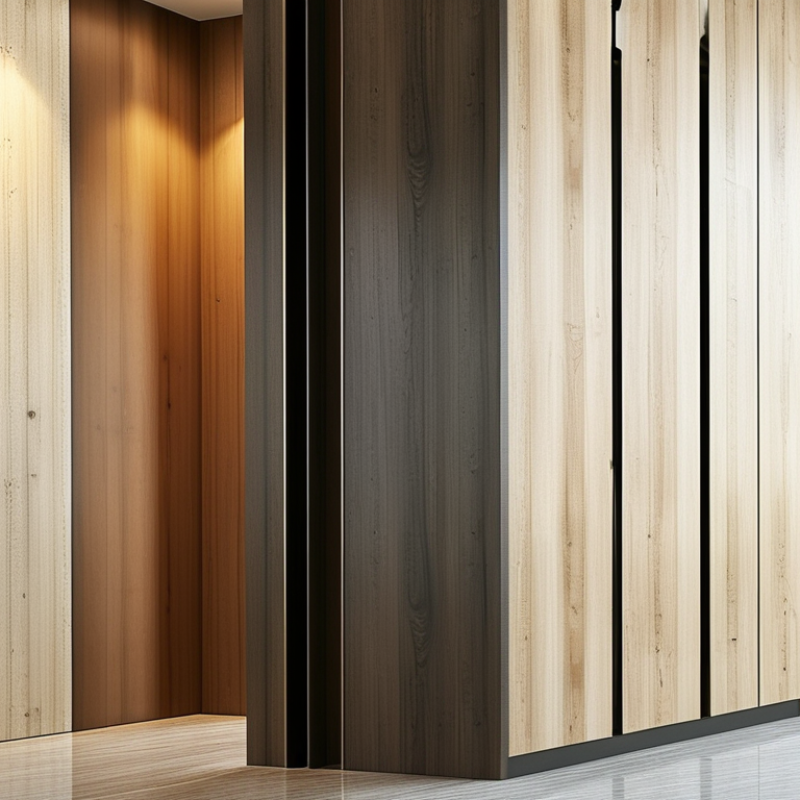
    China Best Laminated Wood Veneer Panels Supplier?

    What Are Laminated Wood Veneer Panels? Veneer Thicknesses of 0.6–2.0 mm

    China Best Laminated Wood Veneer Panels Supplier?

    Laminated wood veneer panels combine thin natural wood layers with a stable core, such as plywood or engineered board. Veneer thickness usually ranges from 0.6 to 2.0 mm. A 0.6 mm surface suits decorative furniture faces and curved components. A 1.0–2.0 mm veneer offers deeper sanding tolerance and stronger visual character. The choice is not merely cosmetic.

    In workshop use, moisture control matters as much as appearance. The USDA Forest Products Laboratory’s Wood Handbook explains that wood expands and contracts as moisture changes. Therefore, panel storage should be flat, sealed, and acclimatized before cutting. A clean edge can still hide weak bonding. Inspect glue lines, surface bubbles, core gaps, and veneer matching under angled light. I have seen attractive panels fail after careless conditioning.

    Responsible sourcing also deserves attention. The FAO Global Forest Resources Assessment 2020 recorded 4.06 billion hectares of global forest area. It also reported a net forest loss of 178 million hectares from 1990 to 2020. These figures make traceable timber documentation more than a marketing detail. Ask for species information, formaldehyde testing, moisture data, and production tolerances. Thickness can vary slightly after sanding, so “2.0 mm” should be verified with sampling, not assumed from a catalogue. Quality is measurable.

    Laminated Wood Veneer Panels: Common Veneer Thickness Reference

    Veneer thickness is commonly specified in millimeters. The reference points below span the 0.6–2.0 mm range used for laminated wood veneer panel construction and surface selection.

    Thickness affects material yield, surface appearance, sanding allowance, and panel fabrication requirements. Actual specifications may vary according to wood species, slicing method, panel structure, and project requirements.

    How Do Chinese Panel Standards Measure Quality? E1 Emissions ≤0.124 mg/m³

    China Best Laminated Wood Veneer Panels Supplier?

    For laminated wood veneer panels, E1 emissions are a practical quality checkpoint. Under China’s GB/T 39600-2021 standard, E1 means formaldehyde emissions of no more than 0.124 mg/m³. This value is measured in a controlled climate chamber, not in a finished room. The test method matters. ISO 12460-5 and chamber-based procedures can produce different results. A reliable supplier should provide the test date, panel thickness, conditioning period, and laboratory details. Numbers without conditions are weak evidence.

    The World Health Organization’s Indoor Air Quality Guidelines report recommends keeping indoor formaldehyde below 0.1 mg/m³ for a 30-minute average. That comparison is useful, but not exact. Room size, ventilation, temperature, and nearby furniture can change exposure. In my experience, a panel passing E1 may still create noticeable odor in a small, poorly ventilated bedroom. That is easy to overlook. Quality also depends on veneer moisture, adhesive control, edge sealing, and batch consistency.

    Tips: Ask for recent third-party reports from the actual production batch. Check whether the report covers the same core material and thickness. Request random sampling records, not only a perfect showcase report. If possible, test a sealed room after installation. One report is not the whole truth.

    China Best Laminated Wood Veneer Panels Supplier? - How Do Chinese Panel Standards Measure Quality? E1 Emissions ≤0.124 mg/m³

    Quality Dimension Reference Requirement or Grade Typical Test or Verification Basis Quality Significance
    Formaldehyde Emission E1: ≤0.124 mg/m³
    E0: ≤0.050 mg/m³
    ENF: ≤0.025 mg/m³
    Chinese grading framework GB/T 39600-2021; confirm the test method and laboratory conditions on the report. Lower emissions support healthier indoor air quality. E1 is a commonly specified baseline for interior wood-based panels.
    Panel Moisture Content Common reference range: 6%–14% at delivery, subject to regional climate and project requirements. Oven-dry comparison or calibrated moisture-meter measurement in accordance with the agreed inspection plan. Correct moisture content helps reduce warping, shrinkage, swelling, and installation problems.
    Thickness Accuracy Specify the nominal thickness and permitted tolerance in the purchase specification; a common project reference is ±0.20 mm. Measure at multiple points with a calibrated micrometer, avoiding panel edges and visible defects. Consistent thickness improves machining accuracy, joint alignment, and finished-surface appearance.
    Length and Width Tolerance Set the permitted tolerance according to the panel format and end-use; a common purchasing reference is ±2 mm per nominal dimension. Measure with a calibrated steel tape or digital measuring system at room temperature. Accurate dimensions reduce cutting waste and simplify installation or downstream fabrication.
    Flatness and Warping Use a project-defined maximum deviation, commonly assessed with a straightedge over the panel surface. Visual inspection plus straightedge or calibrated flatness measurement on a level surface. Good flatness supports tight joints, uniform lamination, and a smooth final installation.
    Veneer Surface Quality No unacceptable open joints, loose veneer, severe discoloration, bubbling, deep scratches, or visible press marks on the specified face. Inspection under agreed lighting conditions and viewing distance; classify defects before production approval. Surface consistency affects appearance, coating performance, and the amount of post-processing required.
    Bonding Integrity No visible delamination or glue-line failure under the agreed conditioning and inspection procedure. Use the applicable wood-based-panel bonding or delamination test specified in the contract and relevant product standard. Reliable bonding prevents layer separation during cutting, handling, changes in humidity, and service.
    Density and Core Uniformity Verify against the agreed product specification; uniform density is more important than a single universal value for all veneer-panel constructions. Review production records and use density testing or cross-sectional inspection when required. Uniform construction improves screw holding, machining behavior, dimensional stability, and panel strength.
    Surface Adhesion and Finish Compatibility The surface should accept the specified coating, laminating film, paint, or clear finish without peeling, cratering, or uneven absorption. Conduct a sample finishing trial using the actual adhesive or coating system before mass production. A compatibility trial reduces finishing defects and confirms that the panel meets the intended design application.
    Traceability and Documentation Batch number, production date, panel specification, test results, and packing details should be recorded. Check the inspection report, product specification, packing list, and independent test documentation where required. Complete records make quality claims, repeat orders, and non-conformance investigations easier to manage.
    Purchasing note: Emission limits and test results depend on the declared standard, specimen preparation, conditioning, chamber method, and laboratory procedure. Always request a current test report for the exact panel construction and confirm all dimensional and appearance tolerances in the purchase contract.

    Which Supplier Certifications Matter? FSC, ISO 9001, and Factory Test Reports

    China Best Laminated Wood Veneer Panels Supplier?

    Supplier certificates can reveal more than polished product photos. In practice, I check whether FSC documentation covers the actual veneer panels, not only the company’s raw timber. The certificate number, validity date, and chain-of-custody scope should match the quoted materials. Small mismatches matter. Ask for current copies.

    ISO 9001 shows that a supplier follows a documented quality system. It does not guarantee perfect panels. A reliable factory should explain how it controls veneer moisture, adhesive spread, pressing temperature, and surface inspection. During a factory review, request production records from a recent batch. Look for measurable limits, not vague promises. Details matter.

    Factory test reports provide the most useful product evidence. Check panel thickness, bonding strength, formaldehyde emission, moisture content, and surface quality. Reports should identify the tested product, batch number, test method, and testing date. An internal report can help, but independent laboratory verification gives stronger confidence. I would also compare the report with a physical sample before placing a large order.

    One missed detail can become a costly shipment problem. Ask who signs each report and how rejected panels are handled. A supplier that admits occasional defects may be more credible than one claiming zero failures. Still, that claim needs records, corrective actions, and repeat testing. Certification opens the conversation; consistent evidence earns trust.

    What Technical Data Should Buyers Compare? 6–18 mm Panels and 6–14% Moisture

    When comparing a laminated wood veneer panel supplier, buyers should inspect more than appearance. For 6–18 mm panels, request actual thickness, tolerance, density, veneer grade, and core construction. A 12 mm panel may look uniform, yet uneven layers can weaken screw holding and create visible ripples. EN 310 provides a recognized method for testing bending strength and stiffness. EN 322 measures panel moisture content through the oven-dry method. Ask for recent laboratory results, not only a factory specification sheet.

    Moisture deserves close attention. The USDA Forest Products Laboratory’s Wood Handbook, 2021, explains that wood changes dimensions as its moisture content changes. For many interior applications, a 6–14% range is a practical comparison point, but project climate still matters. Too dry can cause brittle edges. Too wet can cause swelling, open joints, or later warping. A handheld meter is useful, but it is not perfect. I would sample several panels from different bundles and record readings before loading.

    Check the test date. Moisture changes during storage and transport. Also compare formaldehyde emissions, adhesive type, surface defects, and batch consistency against applicable standards. The European Panel Federation’s technical guidance emphasizes controlled production and documented performance for wood-based panels. Reports can be polished. Physical samples still matter. Ask for a cut edge, inspect veneer continuity, and test a screw near the panel edge. Small details often reveal a supplier’s real process control.

    How Can Buyers Select China’s Best Supplier? MOQ, Lead Time, QC, and Incoterms

    Choosing China’s best laminated wood veneer panel supplier starts with your project’s real numbers. Ask for MOQ by thickness, finish, and panel size, not one catalog figure. A 200-panel minimum may suit a hotel fit-out, but it can burden a small showroom. Request samples from the same production line. Samples can mislead. Confirm veneer species, core material, emissions class, moisture range, and edge treatment in writing.

    Lead time should include approval, production, inspection, packing, and port handling. A supplier may quote 25 days, but first orders often need longer. Build buffer days for veneer matching and replacement panels. Ask what happens when color variation exceeds the approved sample. A clear corrective process shows practical experience. Promises are not schedules. One purchasing lesson is uncomfortable: buyers often accept optimistic dates without checking factory capacity, holidays, or material availability.

    Quality control needs measurable checkpoints. Require moisture testing, thickness checks, bonding inspection, and carton photographs before shipment. For large projects, consider independent pre-shipment inspection. Check inspection records, corrective reports, and recent export references while protecting confidential details. Incoterms also change your landed cost. Under FOB, you usually manage ocean freight after loading; under CIF, confirm destination charges carefully. Ask who handles export documents, insurance, damage claims, and customs coordination. A supplier may be technically strong but weak at communication. That weakness becomes expensive. Compare written quotations, test evidence, production photos, and response speed before choosing.