
Request A Quote

Phone: 416-244-6476
Email:

    China Top 10 Wood Cutting Board Set Suppliers

    China has become a major sourcing base for household kitchenware, including bamboo, rubberwood, acacia, and beech products. Its manufacturing clusters offer varied materials, machining capabilities, packaging options, and export experience. This makes a supplier comparison useful, but not simple.

    Grand View Research estimates that the global kitchenware market will continue expanding through 2030, supported by household consumption, food preparation, and hospitality demand. Its market analysis also highlights the growing value of durable and sustainable product materials. Meanwhile, UN Comtrade trade data shows China remains a significant exporter of wooden household articles and related kitchen products. These figures indicate opportunity, not automatic quality.

    A reliable Wood Cutting Board Set supplier should demonstrate more than attractive catalog photos. Buyers need to examine wood species, moisture control, edge finishing, glue compliance, packaging strength, and production consistency. A board may look smooth in a sample, yet warp after several weeks in a damp kitchen. That detail matters.

    This guide reviews China’s top 10 Wood Cutting Board Set suppliers through a practical sourcing lens. It considers product range, manufacturing experience, customization, quality systems, export capability, and buyer feedback. Certifications such as FSC, BSCI, ISO, or food-contact documentation may support credibility, but certificates should be verified directly.

    No ranking is flawless. Supplier strengths can change with order volume, factory workload, and material availability. Some companies communicate well but provide limited technical evidence. Others manufacture strongly yet respond slowly. Readers should treat this list as a starting point, then request samples, inspection records, and current quotations before making a purchasing decision.
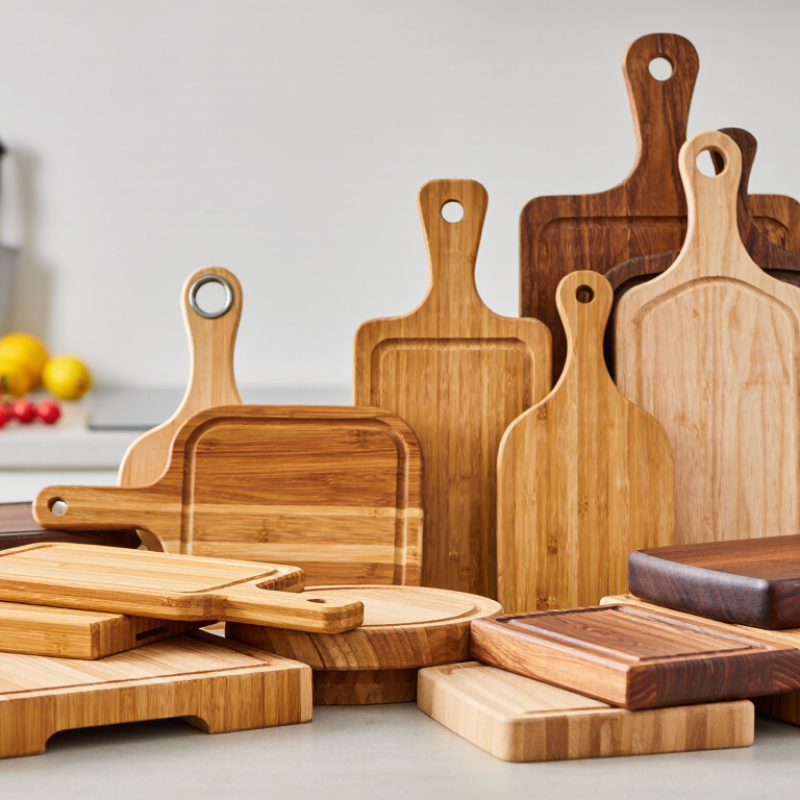
    China Top 10 Wood Cutting Board Set Suppliers

    Scope and Ranking Criteria: 10 Suppliers Across 4 Industry Metrics

    China Top 10 Wood Cutting Board Set Suppliers

    Scope and Ranking Criteria: 10 Suppliers Across 4 Industry Metrics

    This ranking evaluates ten Chinese wood cutting board set suppliers through four practical metrics: material quality, production capacity, customization, and export reliability. Each metric carries 25 points, creating a 100-point assessment. Material quality covers wood species, moisture control, edge finishing, and food-contact documentation. Production capacity considers monthly output, equipment, and repeat-order stability. Customization reviews sizes, packaging, engraving, and private-label flexibility. Export reliability measures lead times, inspection records, and shipment consistency.

    The framework also reflects wider industry evidence. FAO’s 2024 Forest Products Yearbook recorded about 4 billion cubic meters of global roundwood production in 2023. That scale shows why traceable sourcing matters, even for small kitchen products. Trade data under HS 4419 can help verify wooden tableware export activity, but classification is not always precise. This is an imperfect limitation. Supplier claims still require factory audits, sample testing, and moisture checks. A polished sample can hide weak batch control. The ranking therefore gives more weight to documented performance than attractive catalogs. Small details matter: a clean 3-millimeter bevel, stable board thickness, sealed cartons, and dry warehouse storage can separate reliable supply from costly rework. Some scores may change after onsite verification. That is exactly where careful buyers should remain skeptical.

    China Top 10 Wood Cutting Board Set Suppliers - Scope and Ranking Criteria: 10 Suppliers Across 4 Industry Metrics
    Rank Anonymous Supplier Product Scope Wood types and set formats / 25 Food-Contact Readiness Documentation and material controls / 25 Customization Capability OEM, packaging, and finishing options / 25 Export Responsiveness Lead-time and export support / 25 Total Score
    1 Supplier 01 24 24 23 24 95
    2 Supplier 02 23 23 24 23 93
    3 Supplier 03 22 24 22 23 91
    4 Supplier 04 23 22 22 22 89
    5 Supplier 05 21 23 21 22 87
    6 Supplier 06 22 21 21 21 85
    7 Supplier 07 20 22 20 21 83
    8 Supplier 08 21 20 20 20 81
    9 Supplier 09 19 21 19 20 79
    10 Supplier 10 19 20 19 19 77

    Ranking methodology: Each supplier is assessed on four equally weighted industry dimensions, with a maximum score of 25 points per dimension. The table uses anonymized supplier identifiers and is intended for preliminary sourcing comparison. Buyers should verify current certifications, food-contact documentation, wood species, production capacity, minimum order quantity, and delivery terms directly with each supplier.

    Wood Species and Board Formats: 3 Core Materials and 18–40 mm Thickness

    China Top 10 Wood Cutting Board Set Suppliers

    Wood species strongly influence a cutting board’s safety, stability, and service life. China’s leading suppliers commonly work with bamboo, rubberwood, and walnut. Bamboo offers a firm surface and consistent grain. It also grows quickly, but excessive hardness may feel harsh on knife edges. Rubberwood provides a balanced texture and attractive pale color. It needs careful kiln drying to reduce movement. Walnut has a rich appearance and stable structure. However, it usually costs more and may show knife marks sooner.

    Board thickness usually ranges from 18 to 40 mm. An 18 mm board is easier to lift and suits small kitchens. A 25 mm format gives better daily stability without feeling heavy. Boards from 30 to 40 mm feel substantial on a countertop. They also resist warping better when moisture is controlled. I have found that thicker is not always better. A heavy board can become inconvenient during washing and storage.

    Reliable suppliers should document wood origin, moisture testing, edge finishing, and food-contact coating details. Look for smooth corners, even surfaces, and silicone-free feet when required by the buyer. Small gaps near glued joints deserve attention. They may widen after repeated soaking. Some suppliers improve consistency through sample testing, yet even good samples cannot predict every production batch. Buyers should review grain direction, packaging protection, and dimensional tolerance before placing larger orders.

    Food-Contact Compliance: FDA, LFGB, and EU Regulation 1935/2004

    China’s top wood cutting board set suppliers should prove food-contact compliance before discussing price or volume. The 2022 FDA Food Code permits hard maple or equivalently hard, close-grained wood for cutting boards. It also expects food-contact surfaces to remain smooth, durable, and cleanable. This is a practical benchmark, not an FDA product approval.

    For European buyers, Regulation (EC) No. 1935/2004 requires materials to avoid transferring substances that could harm health, alter food composition, or damage taste and odor. LFGB assessment adds another layer, especially for sensory transfer and extractable substances. Suppliers should provide wood species, coating details, migration test conditions, and laboratory accreditation. Ask for batch traceability too. Paperwork can look perfect.

    In factory audits, inspect end-grain joints, glue lines, edge cracks, and drainage after washing. Moisture meters are useful, but readings vary with temperature and wood direction. That limitation deserves attention. A 2023 global food-contact materials market report by Smithers identifies regulatory compliance and traceability as major purchasing concerns, yet wooden products remain highly dependent on processing quality. Supplier declarations should match the actual board, not a generic template. Small details matter: a painted logo, unverified oil, or mixed wood species can change the compliance assessment.

    Manufacturing Benchmarks: 6–12% Moisture Content and Edge-Grain Quality

    China Top 10 Wood Cutting Board Set Suppliers

    Moisture control separates durable cutting boards from attractive failures. The USDA Forest Products Laboratory’s Wood Handbook, 2021, places typical indoor wood equilibrium moisture near 6–12% under common humidity conditions. This range supports a practical manufacturing benchmark for Chinese suppliers. Boards above 12% may shrink after entering dry kitchens. Boards below 6% can become brittle or develop surface checking. Neither result is ideal.

    Professional buyers should request moisture records for each production batch. ASTM D4442 provides recognized methods for measuring moisture in wood. A reliable factory should test several points, not only the board’s edge. Edge-grain construction also deserves close inspection. Long, upright strips should show consistent alignment, tight glue lines, and minimal color gaps. The USDA handbook notes that grain direction influences dimensional movement. That matters when a board meets water, heat, and repeated knife pressure. In practice, edge-grain boards often resist deep knife scoring better than ordinary flat-sawn panels, but workmanship still decides the outcome. It is not magic.

    Tips: Ask for moisture readings before packaging and after conditioning. Check whether the supplier records kiln settings, conditioning time, and room humidity. Inspect three boards from different cartons. Look for raised joints, hairline cracks, and uneven feet. A claimed 8% reading means little without test location and instrument calibration.

    Supplier comparisons should include kiln control, edge-grain layout, adhesive compliance, and traceable inspection reports. Some factories may optimize numbers for inspection day. That possibility deserves attention. A strong supplier can explain its 6–12% target, testing frequency, and corrective action when readings drift.

    China Wood Cutting Board Manufacturing Benchmarks

    The chart presents anonymized benchmark profiles for ten manufacturing specifications. Moisture content is shown against the commonly used 6–12% target range, while edge-grain quality indicates the percentage of inspected board area meeting consistent grain orientation, joint alignment, and surface-finish requirements. These figures are benchmark reference points rather than disclosed company data.

    Supplier Profiles: MOQ, Lead Time, Capacity, FSC, and ISO 9001 Certification

    China’s top wood cutting board set suppliers differ sharply in MOQ, lead time, and production scale. A practical supplier profile should show these figures clearly, not hide them behind broad claims. Many factories quote MOQs from 300 to 1,000 sets, while custom packaging may require more. Confirm whether the MOQ applies per design, color, or full order.

    Lead time often ranges from 25 to 50 days after artwork approval. Sampling may add one to two weeks. Capacity also needs context. A monthly output of 50,000 sets sounds strong, but available capacity can fall during holiday production peaks. Ask for a current production schedule, not an old factory introduction.

    FSC certification can support responsible wood sourcing, but buyers should check certificate scope and validity. ISO 9001 certification indicates a documented quality system, not flawless products. Request recent certificates, inspection records, and photos of packed goods.

    In my experience, edge sanding and moisture control create the most visible differences. A board may look attractive in a sample, then arrive rough at scale. That risk deserves a written inspection standard.

    Some supplier profiles omit rejection rates or replacement policies. That omission matters. Procurement teams should compare landed cost, packaging strength, communication speed, and corrective-action records alongside price.