
How to Choose a Dry Type Transformer Substation?
Choosing a Dry Type Transformer Substation is a design decision, not a product shortcut. The choice affects safety, efficiency, maintenance, noise, and future capacity. In a basement, hospital, factory, or data center, space and ventilation can change the answer quickly. A dry-type unit removes liquid leakage concerns, but it still needs disciplined thermal management.
The U.S. Department of Energy reported that distribution transformer losses represent approximately 2.5% of national electricity consumption. Its 2024 energy-efficiency rule also reinforces the value of reducing losses across large installed fleets. The International Energy Agency expects global electricity demand to grow strongly through 2026, increasing pressure on reliable distribution equipment. These figures support careful evaluation, but they do not replace site measurements. Load profiles can be surprisingly uneven.
Dr. J. C. Das, a recognized power-systems engineer and transformer author, observes, “Transformer selection is a system decision, not a catalog decision.” That principle deserves attention. Check continuous load, short-circuit levels, ambient temperature, altitude, harmonics, enclosure rating, and fire requirements. Compare aluminum and copper windings carefully. Review IEC 60076-11 and IEEE C57.12.01 compliance. Ask for temperature-rise, partial-discharge, and acoustic test results. Do not rely only on the nameplate.
A practical review should include cable routing, access for replacement, cleaning intervals, and spare-part availability. Dry type does not mean maintenance-free. Dust on cooling ducts can raise operating temperature and shorten insulation life. Some projects also underestimate future load growth. That mistake is expensive. A technically sound introduction should therefore connect published data, verified testing, and real operating conditions before recommending any Dry Type Transformer Substation.
What Is a Dry Type Transformer Substation?
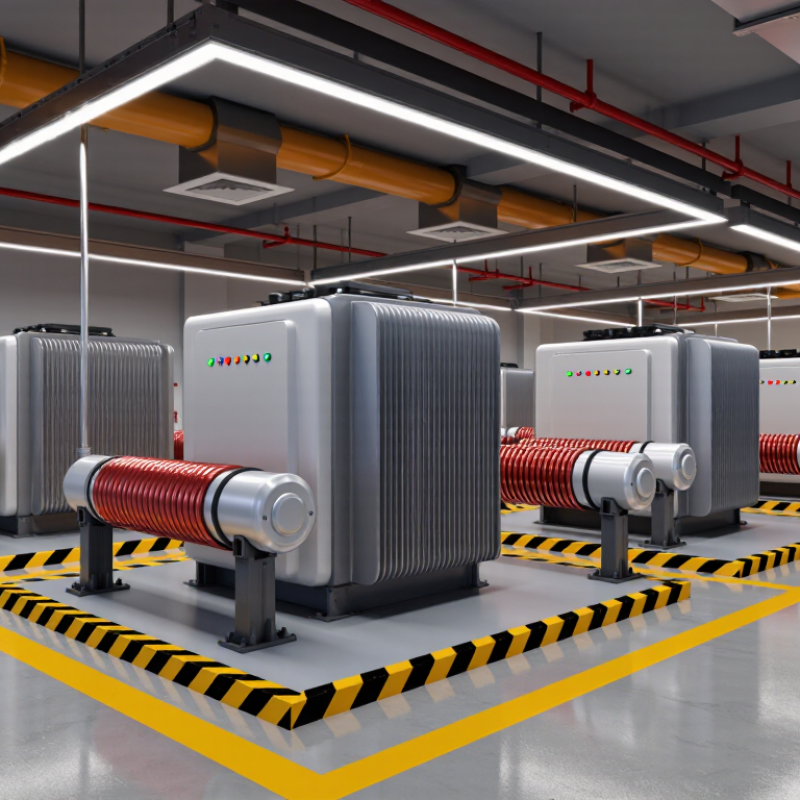
A dry type transformer substation is an electrical facility that changes medium voltage into usable low voltage without liquid insulation. It typically contains a dry type transformer, medium-voltage switchgear, low-voltage distribution equipment, protection devices, grounding systems, and an enclosure. Instead of oil, the transformer relies on solid insulation and surrounding air. Cast-resin designs often protect windings from moisture, dust, and mechanical stress.
This arrangement suits factories, commercial buildings, hospitals, tunnels, and crowded urban sites. Fire risk is generally lower because no transformer oil is stored. Maintenance can also be simpler, although ventilation remains essential. Heat must escape through correctly sized openings or cooling systems. During site inspections, engineers should check cable bending space, access doors, noise levels, and the distance from combustible materials. Small oversights matter.
Choosing a suitable substation starts with the actual load profile, not only the rated capacity. Review continuous demand, motor starting current, harmonics, fault levels, ambient temperature, altitude, and future expansion. A unit operating near its limit may overheat during a summer peak. That is easy to underestimate. Confirm the required enclosure rating, short-circuit withstand, insulation class, efficiency, and applicable electrical standards. Commissioning should include insulation resistance tests, protection testing, phase checks, grounding verification, and thermal monitoring under load. No design is perfect. A realistic maintenance plan and clear operating access often matter as much as the transformer itself.
How to Choose a Dry Type Transformer Substation? - What Is a Dry Type Transformer Substation?
| Selection Dimension | Typical Data or Range | What to Check Before Selection |
|---|---|---|
| Definition | A transformer that transfers electrical energy between voltage levels without liquid insulation or cooling oil. | Confirm that the installation requires an indoor or environmentally controlled, oil-free transformer solution. |
| Common Construction | Cast-resin or resin-encapsulated windings; some designs use ventilated, varnish-impregnated windings. | Choose cast resin for locations requiring stronger protection against moisture, dust, and mechanical stress. |
| Rated Capacity | Common distribution ratings range from approximately 100 kVA to 3,150 kVA; larger ratings are also available for specific systems. | Calculate the connected load, demand factor, motor starting current, harmonic load, and planned future expansion. |
| Primary Voltage | Often used on medium-voltage systems from about 3.3 kV to 35 kV, depending on the local distribution network. | Match the primary voltage, system frequency, insulation level, and utility connection requirements. |
| Secondary Voltage | Typical low-voltage outputs include 400 V, 415 V, 440 V, 480 V, and 690 V, subject to local standards. | Verify the required line-to-line voltage, line-to-neutral voltage, phase arrangement, and grounding method. |
| Phase Configuration | Three-phase units are standard for commercial, industrial, and utility distribution applications. | Confirm whether a three-phase transformer or a bank of single-phase transformers is appropriate. |
| Frequency | Usually 50 Hz or 60 Hz. | Select a frequency-compatible design and ensure the transformer is suitable for the intended power system. |
| Cooling Method | AN: natural air cooling; AF: forced-air cooling using fans. Some units support both modes. | Use natural cooling for normal loading and consider forced air when higher continuous capacity is required. |
| Insulation and Temperature Rise | Common insulation systems are designed for elevated thermal classes, with temperature-rise limits selected according to the applicable standard. | Check insulation class, permissible temperature rise, overload requirements, and the site ambient temperature. |
| Efficiency and Losses | Efficiency is generally high, but no-load loss and load loss vary with capacity, voltage, core material, and design. | Compare guaranteed no-load loss, load loss, total ownership cost, and expected annual load profile. |
| Short-Circuit Impedance | Distribution transformers commonly use an impedance of approximately 4% to 8%, depending on the rating and design. | Balance fault-current limitation against voltage regulation and compatibility with downstream equipment. |
| Enclosure and Protection | Open construction may be used in clean electrical rooms; enclosed designs can provide protection such as IP20, IP23, IP31, or IP等級 specified by the project. | Select the enclosure according to dust, water, accidental-contact, ventilation, and indoor or outdoor conditions. |
| Ambient Conditions | Standard designs are commonly rated for an ambient temperature around 40°C maximum, subject to the applicable standard and derating rules. | Account for altitude, humidity, dust, corrosive gases, solar radiation, ventilation, and abnormal temperature conditions. |
| Noise Level | Audible noise depends on capacity, core flux density, enclosure, cooling fans, and installation conditions. | Request a guaranteed sound level when installing near offices, hospitals, residential areas, or other noise-sensitive spaces. |
| Tap Changer | Off-circuit taps, commonly in steps such as ±2 × 2.5%, may be provided for voltage adjustment while de-energized. | Check the available tap range and ensure the tap position matches the actual primary-system voltage. |
| Monitoring and Protection | Optional devices include winding temperature sensors, temperature controllers, cooling-fan control, overtemperature alarms, and trip contacts. | Specify alarm, trip, remote-monitoring, fire-protection, and integration requirements before ordering. |
| Applicable Standards | Common references include IEC 60076-11 for dry-type transformers and IEEE C57.12.01 for dry-type distribution and power transformers. | Use the standard required by the project, authority having jurisdiction, utility, or local electrical code. |
| Fire and Environmental Benefits | No liquid insulation means no oil leakage and generally lower liquid-fire risk compared with oil-immersed transformers. | Do not eliminate required fire barriers, clearances, ventilation, or protection measures without approval from the responsible engineer. |
| Installation Location | Common locations include commercial buildings, factories, data centers, renewable-energy facilities, hospitals, and infrastructure projects. | Verify room dimensions, access route, floor loading, working clearances, cable entry, ventilation, and maintenance space. |
| Maintenance Requirements | Routine tasks generally include visual inspection, cleaning, checking connections, inspecting ventilation, and testing protection devices. | Set an inspection schedule based on operating conditions and always de-energize and isolate the equipment before maintenance. |
| Basic Selection Formula | For a three-phase load: S = √3 × V × I, where S is apparent power in VA, V is line voltage in volts, and I is line current in amperes. | Select the next suitable standard rating after considering demand, inrush, harmonics, ambient conditions, and future load growth. |