
Why Choose Commercial Artificial Grass for Your Business?
Commercial Artificial Grass can help businesses create a consistently green, usable landscape without routine mowing or irrigation. But it is not a universal fix. A hotel courtyard, restaurant patio, and retail entrance face different foot traffic, drainage needs, and design demands. The right surface should fit the site, not just the sales brochure.
The resource case deserves careful wording. The U.S. Environmental Protection Agency estimates that landscape irrigation accounts for nearly one-third of residential water use nationwide, or about 9 billion gallons per day. That figure is residential, not commercial, but it shows why reducing irrigation can matter. The Synthetic Turf Council also publishes industry information on synthetic turf’s water-saving potential; actual savings depend on the existing landscape, local climate, and maintenance plan. Numbers need context.
Turfgrass scientist Dr. James B. Beard’s work supports a practical selection principle: match a surface to its intended use, site conditions, and maintenance capacity. This is a paraphrase, not a direct quotation. It matters when choosing pile height, backing, infill, and drainage for a busy property. Ask for product specifications, warranty terms, and installation references. Walk the site after rain. Check where water collects. And inspect a sample in direct sunlight. Commercial artificial grass can reduce routine landscape work, but it still needs cleaning and periodic checks. It is not maintenance-free. Some businesses may find natural planting more suitable, and that is worth admitting. The strongest investment is the one that performs well under real daily use—not merely the one that looks convincing on opening day.
What Commercial Artificial Grass Is and Where Businesses Use It
Commercial artificial grass is a synthetic surface made from grass-like fibers attached to a backing. It is installed over a prepared base, which may include compacted aggregate and a drainage layer. Some systems use infill; others do not. The right construction depends on foot traffic, climate, drainage, and how the space will be used. It is not simply carpet rolled over soil.
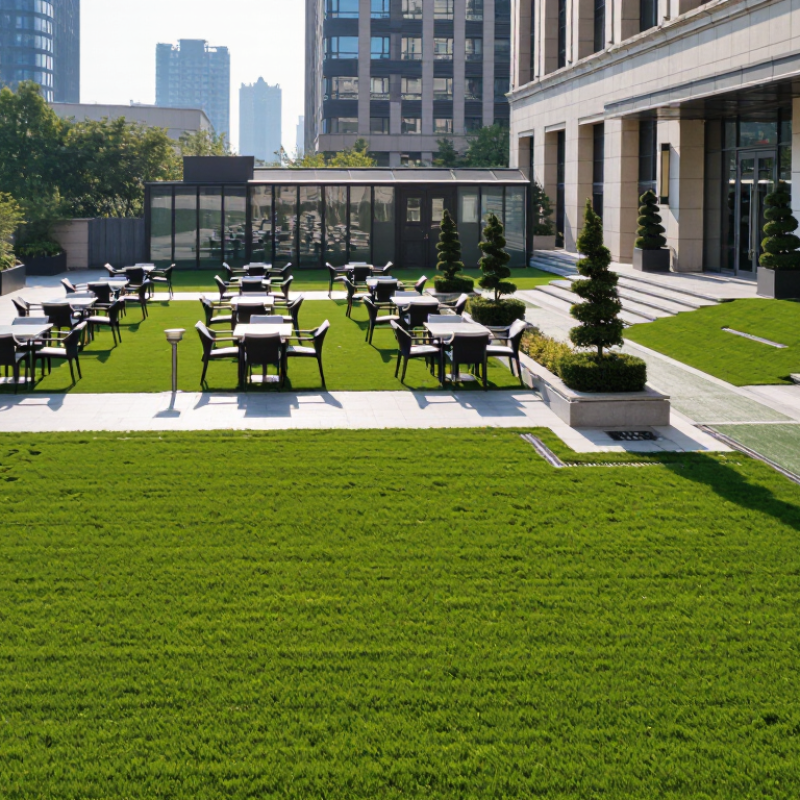
Businesses use it in office courtyards, hotel patios, restaurant terraces, retail displays, and landscaped areas around buildings. A small patch beside an entrance can soften concrete and create a neat place for customers to pause. Larger installations may cover event spaces or recreation areas. Schools and childcare facilities may also use turf in outdoor zones, provided the surface and underlying system suit the intended activity.
Details matter. Near a busy doorway, fibers can flatten faster, so traffic patterns and maintenance access should be considered before installation. A site review should check slopes, drains, shade, and the condition of the existing ground. Dark turf can become hot in direct sun. Leaves and grit still need clearing. It can look consistently green, but it does not behave exactly like living grass. That trade-off deserves attention.
How Artificial Turf Performs in High-Traffic Business Areas
In busy business areas, artificial turf takes repeated footfall without the recovery periods natural grass needs. Think of a hotel courtyard where guests cut across the same narrow path, or an office entrance where chair wheels track over the surface daily. Tufted synthetic fibers resist routine wear, but traffic still compresses infill and can expose seams if installation or upkeep is poor. It is durable, not indestructible.
Testing offers a useful benchmark. FIFA’s Quality Pro football-turf protocol includes 20,200 Lisport XL wear cycles, an accelerated test of surface wear. That does not promise a particular lifespan in a shopping plaza; footwear, furniture, cleaning equipment, drainage, and installation all affect results. For a commercial site, ask for test documentation and inspect high-wear zones regularly. Check edges, seams, infill depth, and areas beneath movable seating. Small problems can spread.
Water savings may also matter. The U.S. Environmental Protection Agency estimates outdoor use accounts for about 30% of household water use nationwide, though the share varies by region. That figure is not a commercial-site estimate, but it highlights why replacing irrigated landscaping can be relevant in dry climates. A practical caution: artificial turf can heat up in direct sun, and debris still needs removal. Consider shade and surface use before specifying it.
Benefits for Maintenance, Appearance, and Year-Round Use
Commercial artificial grass can keep entrances, courtyards, and patio borders looking green without mowing or routine lawn irrigation. The U.S. Environmental Protection Agency’s WaterSense program estimates outdoor use accounts for about 30% of average household water use nationwide. This is a residential benchmark, not a commercial-site estimate, but it highlights the potential value of replacing irrigated lawn. Actual savings depend on climate, area, and cleaning needs. Less mowing, too.
A consistent surface can make a business look cared for through changing seasons, while a properly designed base helps limit muddy footprints after rain. Still, artificial grass is not maintenance-free: staff must remove litter, rinse spills, brush flattened fibers, and inspect seams and infill. Sports-field guidance from the Sports Turf Managers Association recommends regular inspection and surface-specific care. Year-round usability depends on drainage, shade, snow, and local weather. It can look tired. And a uniformly green surface may feel out of place beside mature planting; view the site in person before committing.
Tip: Ask for a drainage plan and a written care schedule. Check a sample in direct sun, then inspect how it looks in shade.
| Business Consideration | Commercial Artificial Grass | Natural Turf | Practical Business Benefit |
|---|---|---|---|
| Routine upkeep | No mowing or routine fertilizing. Surfaces need debris removal and periodic brushing, with frequency depending on traffic and surroundings. | Usually requires regular mowing during the growing season, plus tasks such as edging, feeding, and weed control. | Can reduce recurring groundskeeping tasks and help keep maintenance schedules more predictable. |
| Watering needs | Does not need irrigation to stay green. Water may still be used for cleaning or to cool the surface in hot weather. | May need regular irrigation during dry or hot periods; requirements vary with climate, soil, grass type, and local restrictions. | Can reduce landscape irrigation demand, especially where maintaining living turf would require frequent watering. |
| Appearance through the year | Maintains a consistent green appearance through dormant seasons, subject to cleaning, wear, and product quality. | Color and density change with seasons, weather, foot traffic, and growing conditions. | Provides a more consistent visual setting for entrances, courtyards, and customer-facing areas. |
| Use and recovery | Does not need time to regrow after foot traffic, although heavy use can flatten fibers or wear particular areas. | Heavy or repeated traffic can cause bare patches and compaction; recovery may require reseeding or renovation. | Can be suitable for frequently used spaces when the turf, base, and maintenance plan are matched to expected traffic. |
| Drainage and rain | Permeability depends on the turf backing, sub-base, installation, and site drainage design. | Drainage depends on soil structure, grading, compaction, and weather conditions. | A properly designed installation can help keep outdoor areas usable after rain; site assessment is essential. |
| Heat in direct sun | Can become hotter than natural grass in direct sunlight. Shade, suitable product selection, and occasional rinsing may help manage surface temperature. | Often feels cooler because living plants release water through evapotranspiration, though conditions vary. | Consider shade and intended use when planning customer, staff, or play areas in sunny locations. |
| Service life and replacement | Service life varies with product, installation, UV exposure, traffic, and maintenance; replacement planning should follow site conditions and supplier guidance. | Can be repaired or renewed in sections, but ongoing care and periodic renovation may be needed. | Compare whole-life costs, including installation, maintenance, repairs, and eventual replacement—not just initial price. |
Planning note: These are general comparisons, not guaranteed performance figures. Actual maintenance, water use, drainage, heat, and service life depend on local climate, site design, product specification, installation, and level of use.
Installation Options for Different Commercial Spaces
Why Choose Commercial Artificial Grass for Your Business?
Installation Options for Different Commercial Spaces
Commercial spaces place different demands on artificial grass, so installation should match the surface, foot traffic, and drainage needs. A rooftop terrace may need lightweight materials and clear drainage paths to avoid pooling after rain. The base matters.
On concrete patios or indoor display areas, installers can use a prepared, level surface and secure the turf with suitable adhesive or perimeter fasteners. Seams should sit away from main walking routes where possible. In retail spaces, this can reduce visible joins and help limit edge lifting under frequent foot traffic. For offices, quieter, low-traffic corners may need less intensive anchoring than busy entrances.
Ground-level courtyards usually need excavation, a compacted aggregate base, and a permeable backing that allows water to pass through. Play or recreation areas may require additional impact-absorbing layers, selected for the intended use and site conditions. It is easy to underestimate preparation time. Uneven concrete, poor drainage, or a tight delivery schedule can complicate even a modest project. Before installation, confirm access routes, door clearances, drainage outlets, and maintenance expectations with the installer. A small sample laid in place can also reveal whether the color and pile height suit the surrounding architecture.
Why Choose Commercial Artificial Grass?
Indicative pile-height ranges for common commercial spaces
These ranges illustrate typical product-selection options, not universal standards. Choose turf based on expected foot traffic, drainage, substrate, and the installation system; check product specifications for each project.
Costs, Safety, Drainage, and Other Selection Factors
Commercial artificial grass can reduce mowing, watering, and mud, but the purchase price is only part of the cost. Compare site preparation, edging, infill, installation, and eventual repairs. A small sample may look convincing. It cannot show how seams will hold up across a busy entrance or how the surface feels after months of use. Ask for a site-specific estimate and a clear maintenance plan.
Safety depends on the whole surface system, not just the grass fibers. Check slip resistance and, where falls are a concern, request impact-attenuation testing for the proposed base and infill. Consider heat, too: artificial turf can become uncomfortable under strong sun. Shade may help, but it is not a complete fix. A surface is not automatically safe because it looks soft.
Drainage deserves a close inspection. Water should pass through the turf and move across a correctly graded, permeable base toward suitable outlets. Look for standing water after rain, and ask how the subsoil affects drainage. Poor preparation can leave puddles, odors, or uneven spots. That is costly. Compare options in the conditions your business actually faces, including foot traffic, cleaning needs, and shade. No specification replaces a careful site assessment, and that part is sometimes overlooked.
