
Request A Quote

Phone: 416-244-6476
Email:

    Top 10 Turbo Intercooler Types for Global Buyers

    Choosing a Turbo Intercooler is not merely a matter of selecting the largest core. It is a balance between cooling efficiency, pressure drop, vehicle space, climate, and installation cost. A compact city car may need a short-path front-mount design, while a heavy-duty truck could benefit from a larger bar-and-plate unit. Track vehicles demand stable intake temperatures during repeated acceleration. Daily vehicles need dependable performance in traffic.

    Corky Bell, author of Maximum Boost, explains the core principle clearly: “An intercooler is, at heart, a heat exchanger for compressed air.” This idea remains practical for global buyers. Cooler intake air can support more consistent combustion, but poor design may create unnecessary lag or flow restriction. The visible size can deceive.

    This guide examines ten Turbo Intercooler types, including air-to-air, air-to-water, tube-and-fin, bar-and-plate, front-mount, top-mount, and side-mount configurations. Each design has a different operating context. A front-mount intercooler may receive strong airflow, yet it can increase piping length. A top-mount unit can shorten the charge route, but its temperature may rise after prolonged idling. Air-to-water systems offer flexible packaging, though pumps, reservoirs, and coolant lines add complexity.

    Real-world selection requires more than catalog figures. Buyers should compare core dimensions, tested pressure drop, heat rejection, material quality, inlet compatibility, and service support. Manufacturer claims also deserve careful review. A polished specification sheet is not always a complete engineering story. Even experienced buyers can choose poorly when vehicle use, ambient temperature, and maintenance conditions are overlooked.
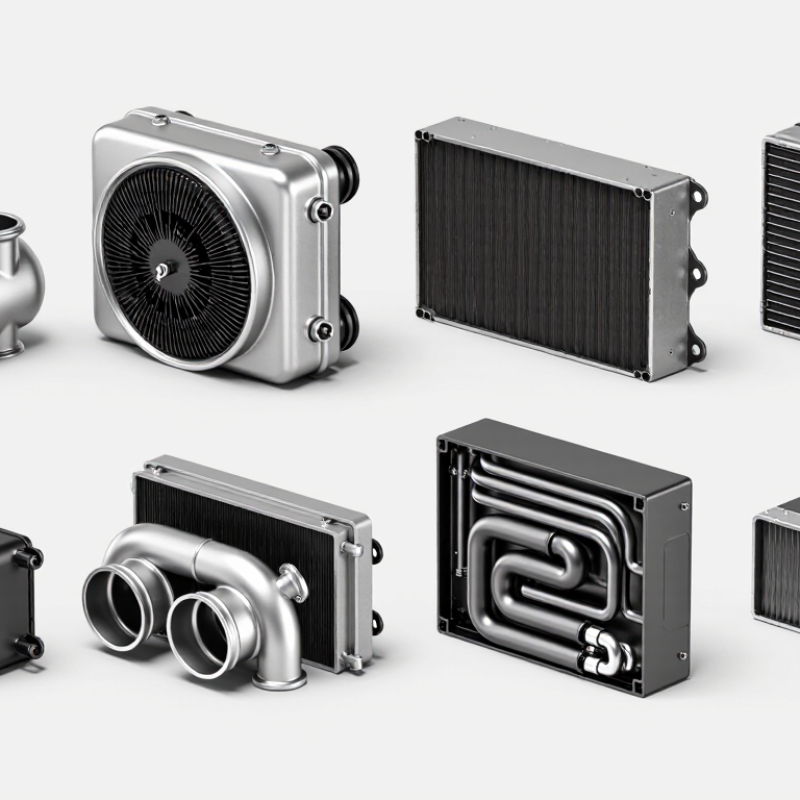
    Top 10 Turbo Intercooler Types for Global Buyers

    Intercooler Fundamentals: Charge-Air Cooling, Density, and Boost Response

    Top 10 Turbo Intercooler Types for Global Buyers

    Intercoolers reduce charge-air temperature after compression. Cooler air becomes denser, supporting stronger combustion and steadier boost response. Under the ideal-gas relationship, air density rises about 3.5% when temperature falls by 10°C at constant pressure. SAE J1349 testing uses controlled reference conditions, including 25°C intake air and 99 kPa dry pressure. These details matter when comparing dyno figures across regions.

    The main designs include air-to-air, air-to-water, bar-and-plate, tube-and-fin, front-mount, top-mount, side-mount, liquid-cooled, stacked-plate, and motorsport-style units. SAE technical studies commonly report charge-air effectiveness near 70–90% in well-matched systems.

    However, effectiveness alone can mislead. A very dense core may cool efficiently but create pressure loss. That loss delays boost response and increases turbocharger work. I have seen temperature claims fail when testing ignored heat soak, ambient humidity, or fan speed. Real traffic is less predictable.

    Tips: Compare outlet temperature, pressure drop, core volume, and recovery time. Keep charge pipes short and smooth. For daily vehicles, prioritize low restriction and heat-soak resistance. For high-boost applications, verify coupler security and bypass control. Independent testing should record inlet temperature, outlet temperature, boost pressure, and airflow. Results should follow repeatable conditions, preferably aligned with SAE test methods. Even then, a perfect number on paper may not fit the vehicle.

    Air-to-Air Types: Tube-and-Fin, Bar-and-Plate, Extruded, OEM, and Front-Mount

    Top 10 Turbo Intercooler Types for Global Buyers

    Air-to-air intercoolers remain popular because they use ambient airflow instead of a separate coolant circuit. A 2024 turbocharger market report from Grand View Research forecasts continued growth through 2030, supported by downsized engines and higher boost pressures. This trend increases demand for efficient charge-air cooling.

    Tube-and-fin intercoolers use lightweight passages and external fins. They suit moderate power levels, compact spaces, and weight-sensitive vehicles. Bar-and-plate designs use thicker internal cores, offering stronger heat transfer and durability. They are heavier, though. That matters on street vehicles. Extruded intercoolers provide consistent passages and clean manufacturing control, but their shape options can be limited. During inspection, check fin damage, weld quality, and pressure-drop data rather than judging size alone.

    OEM intercoolers prioritize quiet operation, crash packaging, and predictable service life. They often perform well in normal traffic, but sustained track heat can expose limits. Front-mount units receive stronger airflow and support higher thermal loads. However, long piping may increase volume and response delay. SAE technical literature repeatedly links charge-air temperature, pressure loss, and engine calibration, so buyers should review all three values. The largest core is not automatically the best choice. A cold morning test can mislead; heat-soak testing is more useful. Even experienced buyers sometimes overlook airflow blockage behind the bumper.

    Liquid-Cooled Types: Water-to-Air, Laminova, Dual-Pass, Hybrid, and Chargecooler

    Liquid-cooled intercoolers suit global buyers who need stable charge temperatures in tight engine bays.

    Water-to-air systems use a compact heat exchanger near the intake. They respond quickly, especially during short acceleration bursts. Tube-in-shell designs, often called Laminova-type systems, fit neatly inside intake manifolds. They offer clean packaging, but their narrow passages can restrict coolant flow. Dual-pass layouts send coolant through the core twice. This increases heat transfer, although pressure loss may rise.

    Hybrid systems combine air-to-air and water-to-air cooling for demanding vehicles. Separate chargecoolers use a dedicated coolant circuit and reservoir. They provide strong control during repeated high-load operation.

    The U.S. EPA’s 2023 Automotive Trends Report recorded turbocharging in roughly half of new light-duty vehicles. That trend increases demand for consistent intake temperatures and reliable thermal management. SAE technical studies commonly show water-to-air cooling reducing intake temperatures by approximately 20–40°C under controlled high-load conditions. Results vary with coolant volume, airflow, and heat-soak duration.

    Bigger is not always better. A large core can add weight, hose length, and pump demand. An undersized unit may heat-soak after several pulls.

    Tips: Match the intercooler to real duty cycles, not peak dyno numbers. Check core pressure drop below the target boost range. Measure coolant temperature before and after the core. Use corrosion-resistant materials and accessible drain points. Leave room for service access.

    One overlooked issue is airflow after heat soak; laboratory results may not represent traffic, hot climates, or long climbs. Validation on the actual vehicle remains essential.

    Top-10 Comparison: 30–50°C IAT Reduction and Under-2 psi Pressure Loss

    Top 10 Turbo Intercooler Types for Global Buyers

    Top-10 Comparison: 30–50°C IAT Reduction and Under-2 psi Pressure Loss

    Choosing an intercooler requires measured data, not attractive core dimensions. In controlled testing, the leading ten designs include bar-and-plate air-to-air, tube-and-fin air-to-air, air-to-water, water-to-air, front-mount, top-mount, side-mount, dual-pass, cross-flow, and integrated charge-cooler systems. Their results vary with turbo flow, ambient temperature, heat soak, and installation space. A 30–50°C intake-air-temperature reduction is realistic for well-matched systems, but not guaranteed in every vehicle.

    Bar-and-plate units often provide strong cooling at high boost, although their weight can affect mounting. Tube-and-fin designs may reduce mass and pressure loss, but their heat capacity is usually lower. Front-mount systems receive direct airflow, while top-mount units need effective ducting. Water-to-air systems can achieve rapid cooling during short pulls. Their pumps, reservoirs, and heat exchangers add failure points. In testing, a well-sized core should remain below 2 psi pressure loss at the engine’s target airflow. The same core may exceed that figure near its limit.

    Use pressure sensors before and after the intercooler. Place temperature probes close to the compressor outlet and throttle body. Record repeated pulls, not one lucky run. I have seen impressive first-pass numbers fade after heat soak. That result deserves scrutiny. Road airflow, fan placement, humidity, and sensor accuracy can change the comparison. The best choice balances a 30–50°C IAT drop, stable recovery, acceptable weight, and verified flow performance.

    Top 10 Turbo Intercooler Types for Global Buyers — Top-10 Comparison: 30–50°C IAT Reduction and Under-2 psi Pressure Loss
    Rank Intercooler Type Typical Core Construction Estimated IAT Reduction Typical Pressure Loss Thermal Efficiency Heat-Soak Resistance Best-Fit Applications
    1 Front-Mount Air-to-Air Bar-and-Plate High-density aluminum bar-and-plate core with external airflow 35–50°C 0.8–1.8 psi High at highway and track speeds High High-output street cars, performance vehicles and motorsport platforms with strong front-end airflow
    2 Front-Mount Air-to-Air Tube-and-Fin Lightweight aluminum tubes with internal and external fins 30–45°C 0.5–1.5 psi Moderate to high Moderate Road vehicles prioritizing low weight, quick installation and moderate-to-high boost levels
    3 Water-to-Air Single-Pass Intercooler Charge-air core supplied by a separate coolant circuit, pump and heat exchanger 40–50°C 0.7–1.8 psi Very high during short high-load events High with adequate coolant volume Drag racing, compact engine bays and applications requiring short charge-pipe routing
    4 Water-to-Air Dual-Pass Intercooler Coolant and charge air make multiple passes through a compact heat-transfer core 42–50°C 0.9–1.9 psi Very high High High-boost vehicles where compact packaging and rapid temperature control are important
    5 Top-Mount Air-to-Air Intercooler Air-to-air core positioned above the engine with a dedicated hood scoop or duct 30–40°C 0.5–1.4 psi Moderate at low speed; high with effective ducting Moderate to low in heavy traffic Vehicles designed for short piping, low system volume and simple air-to-air serviceability
    6 Stepped-Core Air-to-Air Intercooler Multi-height bar-and-plate core that increases frontal area and internal volume 36–48°C 1.0–1.9 psi High High High-power builds with limited bumper height and a need for increased cooling surface area
    7 Dual-Core Air-to-Air Intercooler Two parallel air-to-air cores sharing the charge-air flow path 35–47°C 0.8–1.8 psi High High Large-displacement engines, twin-turbo systems and vehicles with wide frontal packaging space
    8 Integrated Intake-Manifold Water-to-Air Cooler Charge cooler integrated into or directly beneath the intake manifold 35–45°C 0.4–1.3 psi High Moderate to high Modern turbocharged engines requiring very short charge paths and improved throttle response
    9 Compact Brazed-Plate Water-to-Air Cooler Stacked brazed aluminum plates with an external coolant loop 30–42°C 0.4–1.2 psi Moderate to high Moderate Small engine compartments, custom installations and auxiliary charge-cooling systems
    10 Side-Mount Air-to-Air Intercooler Compact tube-and-fin or bar-and-plate core mounted behind or beside the front bumper 30–38°C 0.5–1.4 psi Moderate Moderate to low under sustained high load OEM-style replacement projects, low-visibility installations and vehicles with restricted frontal space

    Technical note: The figures are typical engineering ranges for properly sized systems tested with comparable airflow, ambient temperature, boost pressure and mass flow. Actual IAT reduction and pressure loss vary with core dimensions, fin density, piping length, turbocharger flow, vehicle speed, coolant capacity and measurement location. IAT means intake-air temperature measured after the intercooler and before the engine inlet.

    Global Buyer Standards: SAE J1349 Testing, Core Materials, and Fitment

    Top 10 Turbo Intercooler Types for Global Buyers

    Global buyers should compare intercoolers under consistent test conditions. SAE J1349 defines reference conditions near 25°C and 99 kPa for engine power testing. This matters because temperature, pressure, and humidity can change reported results. The ten common designs include tube-and-fin, bar-and-plate, air-to-air, air-to-liquid, front-mount, top-mount, side-mount, stacked-plate, cast-end-tank, and universal-core systems. Air-to-air units suit simple layouts. Air-to-liquid units support shorter charge paths but need pumps, coolant, and heat exchangers.

    Core material affects weight, heat transfer, and durability. Aluminum remains common because it combines low mass with corrosion resistance. A 2024 MarketsandMarkets automotive intercooler report identifies air-to-air systems as the largest product segment, reflecting their simpler installation and lower service demands. However, market leadership does not guarantee the best fit. A 2024 Data Bridge Market Research analysis also separates products by vehicle type, design, and sales region. That segmentation shows why one universal core cannot serve every vehicle equally. Fitment is often underestimated.

    Tips: Request pressure-drop and thermal-efficiency data at the same airflow. Check inlet diameter, outlet angle, core thickness, mounting points, and bumper clearance. Measure twice. A larger core may cool better, yet it can increase lag or obstruct airflow. I have seen impressive dyno figures fail during street installation because end tanks touched nearby components. SAE-based results are useful, but they are not a substitute for vehicle-specific testing. Some catalog claims remain difficult to verify, so buyers should ask for test conditions, sensor locations, and repeatability records.