
2026 Top Carbon Fiber Golf Umbrella Manufacturers?
Choosing a carbon fiber golf umbrella in 2026 requires more than checking its frame material. Buyers now examine canopy coverage, shaft strength, wind recovery, grip comfort, and manufacturer consistency. A lightweight umbrella may feel elegant on the course, yet poor joints can fail after several wet rounds.
Dr. Paolo Feraboli, a respected composites engineer, has stated, “Carbon fiber earns its value through engineering, not appearance.” That principle guides this review of the 2026 top carbon fiber golf umbrella manufacturers. It shifts attention from glossy marketing toward measurable performance, including fiber quality, resin control, connection design, and factory testing.
The leading manufacturers usually combine carbon fiber shafts with reinforced ribs and water-resistant polyester canopies. Some add automatic opening systems, UV protection, oversized vents, or ergonomic handles. These features matter when rain strikes sideways and the wind changes without warning. They also affect weight, price, repairability, and long-term comfort.
This market is not perfectly transparent. “Carbon fiber” can describe different grades, structures, and manufacturing methods. Some product pages provide impressive specifications but limited test evidence. That gap deserves attention.
Our comparison considers published technical details, user experience, quality-control signals, warranty terms, and practical golf-course performance. We also recognize a limitation: factory claims cannot replace independent testing. The strongest brands may still have occasional failures. Reliable choices are not flawless choices. They are manufacturers that explain their materials clearly, control production carefully, and respond responsibly when products fall short.
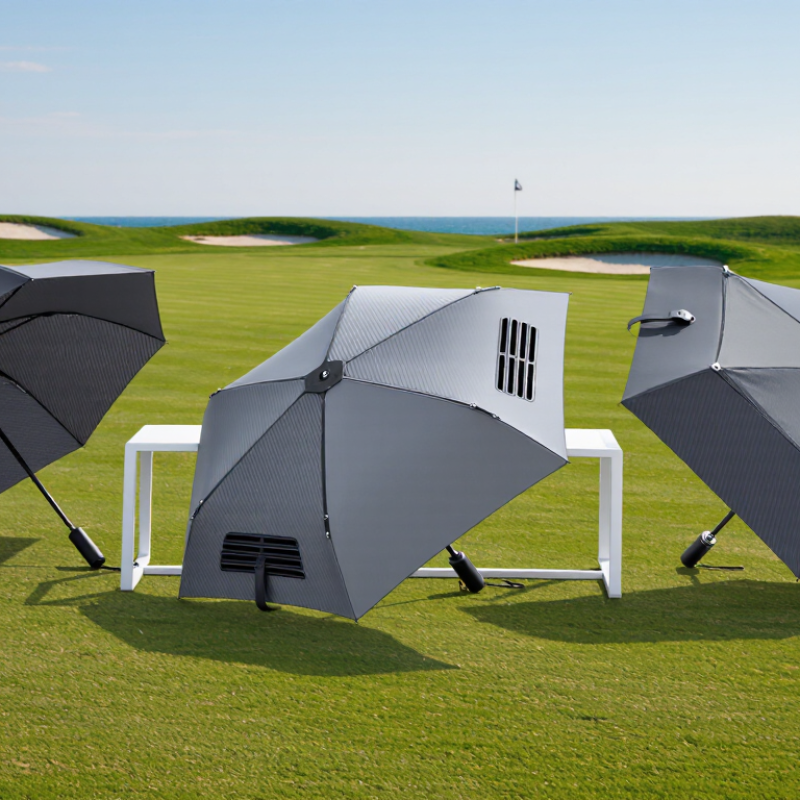
2026 Market Scope: Top Carbon Fiber Golf Umbrella Manufacturers
2026 Market Scope: Top Carbon Fiber Golf Umbrella Manufacturers
The 2026 market is moving toward lighter, stronger golf umbrellas. The R&A’s Global Golf Participation Report recorded 66.6 million golfers outside the United States and Mexico. This expanding user base supports demand for equipment that performs during long outdoor sessions. Carbon fiber shafts can reduce hand fatigue while maintaining stiffness in strong wind. However, a carbon shaft alone does not prove superior quality.
Published estimates from Grand View Research place the global carbon fiber market on a strong growth path through 2030. Umbrella-specific data remains less consistent. That is a weakness. Manufacturers should therefore be assessed through measurable details, including shaft weight, rib recovery, canopy diameter, waterproof coating, and wind-test procedures. A practical model should open smoothly after repeated use and resist frame distortion near the hinge points. The International Organization for Standardization provides relevant testing principles for weather resistance, but golf umbrellas still lack one universal performance standard. Buyers should examine fiber grade, resin quality, stitching density, and factory traceability. Price can mislead. Some lightweight designs feel excellent in-store but become unstable with wet fabric and sudden gusts. Independent testing, documented material specifications, and realistic warranty data offer stronger evidence than marketing claims.
2026 Top Carbon Fiber Golf Umbrella Manufacturers? - 2026 Market Scope: Top Carbon Fiber Golf Umbrella Manufacturers
Anonymous market-screening table based on verifiable product specifications, manufacturing capabilities, material requirements, and quality benchmarks.
| Market Dimension | 2026 Benchmark or Observed Range | Carbon-Fiber Relevance | Recommended Evaluation Evidence | Market Priority |
|---|---|---|---|---|
| Primary Product Format | Single-canopy golf umbrellas generally use a straight-shaft design with a large canopy intended to cover one golfer, golf equipment, or two users. | Carbon-fiber shafts can reduce structural weight while maintaining high bending stiffness when properly designed and manufactured. | Technical drawing, shaft construction description, finished-product weight, and load-test records. | Core requirement |
| Canopy Diameter | Common golf-umbrella canopy sizes are approximately 60–68 inches, measured across the open canopy. | A larger canopy increases the required shaft, rib, joint, and wind-load performance. | Open-canopy diameter, closed length, rib length, and dimensional-tolerance data. | High |
| Shaft Construction | Typical premium configurations include a full carbon-fiber shaft, a carbon-fiber shaft with metallic joints, or a hybrid carbon/fiberglass structure. | Construction consistency is more important than the material label alone; joints and ferrules can determine overall durability. | Material specification, fiber orientation, resin system, joint design, and batch traceability. | Core requirement |
| Rib and Stretcher System | Fiberglass ribs and stretchers are widely used because they provide flexibility and resistance to repeated bending. | A carbon shaft paired with flexible fiberglass ribs can balance low weight, resilience, and cost. | Rib material, rib count, joint construction, fatigue-cycle results, and replacement-part availability. | High |
| Canopy Fabric | Polyester is the dominant umbrella canopy fabric; premium products commonly use tightly woven, water-repellent polyester. | Carbon fiber does not determine waterproofing or ultraviolet resistance; canopy fabric and coating must be assessed separately. | Fabric composition, fabric weight, water-repellency test, colorfastness data, and seam construction. | High |
| Opening Mechanism | Manual opening is generally simpler and lighter; automatic opening adds convenience but increases mechanism complexity and weight. | The opening mechanism must be compatible with the stiffness and alignment of the carbon-fiber shaft. | Opening-cycle test, spring specification, locking-force test, and safety-release design. | Medium |
| Wind-Resistance Validation | Wind performance should be reported using a defined test method rather than unsupported claims such as “storm proof.” | Carbon-fiber shaft stiffness, flexible ribs, canopy venting, and joint strength work together to influence wind behavior. | Test speed, test duration, failure criteria, recovery performance, and independent laboratory report. | Core requirement |
| Water-Repellency Performance | Water repellency is commonly evaluated through standardized textile spray-rating or hydrostatic-pressure methods. | Material selection for the shaft does not replace the need for a tested canopy coating and sealed construction. | Test method, rating result, wash or abrasion durability, and seam-leakage inspection. | High |
| Quality Management | ISO 9001 is a widely recognized quality-management-system standard used for process control and continual improvement. | Consistent fiber layup, resin curing, shaft straightness, and joint assembly require documented process controls. | Valid certificate, certificate scope, audit status, inspection plan, and corrective-action records. | Core requirement |
| Environmental Management | ISO 14001 provides a recognized framework for environmental-management systems, while recycled polyester can reduce reliance on virgin polyester feedstock. | Carbon-fiber production and composite recycling should be assessed separately from canopy-material claims. | Environmental certificate, material declarations, recycled-content evidence, packaging data, and waste-management records. | Medium |
| Customization Capability | Common customization areas include canopy size, panel color, printing, handle shape, sleeve design, packaging, and shaft finish. | Customization should not compromise shaft alignment, resin curing, joint strength, or canopy balance. | Pre-production sample, artwork approval process, color standard, tooling capability, and change-control procedure. | High |
| Supply-Chain Resilience | Key risk points include carbon-fiber or composite-tube supply, metal fittings, fiberglass ribs, canopy fabric, printing, and final assembly. | Dual sourcing and incoming-material inspection reduce the impact of composite-material shortages or quality variation. | Approved-supplier list, material lead times, safety-stock policy, capacity plan, and traceability records. | High |
| Packaging and Transport | Golf umbrellas are typically shipped with individual sleeves or protective packaging to prevent canopy abrasion and shaft damage. | Carbon-fiber shafts can be strong but may be vulnerable to concentrated impact or surface damage during transport. | Packaging drop test, carton specification, moisture protection, pallet configuration, and damage-rate records. | Medium |
| Best-Fit Supplier Profile | Manufacturers with composite-shaft experience, dedicated umbrella assembly, controlled canopy production, and documented quality systems are the strongest candidates. | Specialized composite processing and final-product testing are more meaningful indicators than a carbon-fiber label alone. | Factory audit, production sample, third-party test documents, process flow, and after-sales quality data. | Highest |
Scope note: The benchmarks above are industry evaluation criteria and commonly observed specification ranges. Actual performance varies by design, materials, test method, production process, and order configuration.