
Top Trampoline Manufacturers in China for Global Buyers?
Choosing among Trampoline Manufacturers in China requires more than comparing catalog prices. Global buyers need evidence, not polished claims.
A reliable supplier should show its factory, production controls, material specifications, and testing records. Look closely at steel tube thickness, spring durability, stitching quality, padding density, and net attachment points. These details become visible during installation, not during a sales presentation.
Dr. Keith Alexander, a trampoline safety innovator, once said, “Safety is not an accessory; it is the foundation of the trampoline.” That principle remains practical for international purchasing. Experienced Trampoline Manufacturers should understand ASTM, EN, and other applicable safety expectations. However, certification names alone do not prove consistent quality. Buyers should verify scope, issuing laboratories, inspection dates, and product-model coverage.
This guide examines leading Chinese suppliers through a global buyer’s lens. It considers manufacturing experience, engineering capability, quality assurance, export performance, customization, communication, and after-sales support. Factory scale matters, but it is not everything. A smaller manufacturer may provide closer supervision and faster product changes. A larger one may offer stronger testing facilities and steadier output.
There is room for caution. Online reviews can be incomplete, and factory photographs may show an ideal production day. Ask for recent samples. Request a video inspection. Compare the delivered frame with the approved sample.
The best supplier is not always the cheapest. It is the manufacturer that can repeat safe performance across thousands of units. This overview helps buyers identify that difference before placing a major order.
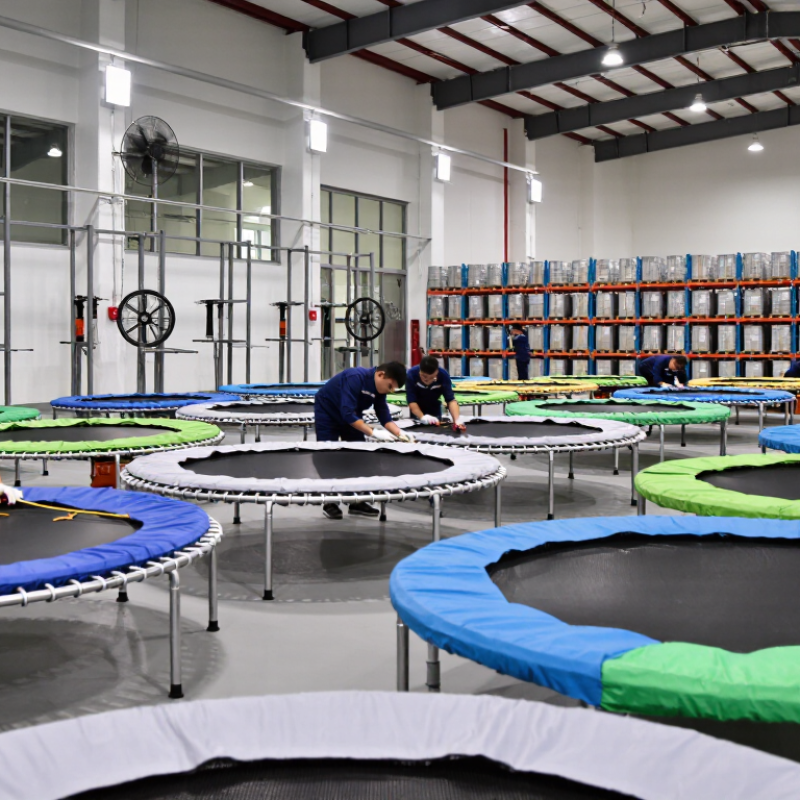
What Defines a Reliable Trampoline Manufacturer in China
A reliable trampoline manufacturer in China should show its process, not only attractive product photos. Global buyers need clear specifications for frame steel, spring length, mat stitching, padding thickness, and net strength. A serious factory can provide material records, production samples, and recent inspection reports. Ask for measured data. Do not rely on general claims.
Factory experience becomes visible during a sample order. Inspect welds for smooth joints, check galvanized surfaces for exposed areas, and test the enclosure poles for movement. Packaging also matters. A well-designed carton protects curved frames and prevents padding from being crushed during long-distance shipping. Small details often reveal larger quality habits.
Reliable manufacturers explain testing methods and accept reasonable third-party inspections. They should communicate production schedules, tolerances, spare-part policies, and corrective actions in writing. Ask how they handle a failed batch. Their answer matters more than a polished sales presentation. No factory is perfect. Even a capable supplier may miss a stitching issue or delay one component. What matters is whether the problem is recorded, corrected, and prevented from repeating. Buyers should compare samples, verify documents, and keep agreed standards in the purchase contract. Clear communication is practical protection.
Leading Chinese Trampoline Manufacturers for International Buyers
For international buyers, choosing a Chinese trampoline manufacturer requires more than comparing quoted prices. Experienced suppliers usually manage frame welding, spring installation, enclosure sewing, and final packing in one production system. Ask for factory photographs, material specifications, and recent quality records. A reliable factory should explain its process clearly. Vague answers deserve caution.
Professional manufacturers test steel tubes, jumping mats, springs, padding, and safety nets before shipment. Request measurable details, such as tube thickness, foam density, stitching strength, and load-testing methods. Independent inspection can verify dimensions, packaging, and visible defects. Compliance documents should match the actual product and destination requirements. Do not rely on a certificate alone. Traceability matters.
International projects also depend on communication. Confirm drawings, logo placement, carton markings, spare parts, lead times, and after-sales procedures in writing. Samples reveal details that sales messages often hide. Small wrinkles, uneven stitching, or unclear instructions may signal larger production weaknesses. No factory is flawless. Buyers should record problems and ask how they will be corrected. A supplier that accepts practical feedback is often easier to develop with, even when the first shipment is not perfect.
Key Product Categories and Customization Options
China’s trampoline manufacturers commonly serve several product categories for global buyers. Backyard models often use galvanized steel frames, safety nets, thick edge padding, and weather-resistant jumping mats. Commercial trampolines usually require stronger frames, replaceable padding, higher user capacity, and easier maintenance access. Fitness rebounders are smaller, lighter, and designed for controlled indoor exercise. Mini trampolines also suit children’s programs, but their structure needs careful stability checks.
Customization can cover diameter, frame height, spring or elastic design, mat color, padding thickness, net structure, and ladder options. Buyers may request printed logos, custom colors, retail packaging, instruction manuals, and barcode labels. A practical factory should provide material specifications, load-test records, stitching samples, and production photos. I would also request a pre-production sample. Digital images rarely show edge softness or frame finishing accurately. Small details matter.
Tips: Define the user age, location, and expected daily use before requesting prices. Ask whether replacement parts remain available after delivery. Confirm testing against the target market’s applicable safety requirements, not only factory standards. A bright color may attract attention, but it can fade outdoors. Custom packaging looks professional, yet excessive printing can increase cost and waste. One overlooked issue is carton size; oversized packages may raise freight charges sharply.
Quality Standards, Safety Testing, and Factory Certifications
For global buyers, selecting a trampoline manufacturer in China requires more than comparing prices. A reliable factory should explain its quality standards, testing process, and production controls clearly. During a factory review, examine frame welding, spring coating, jumping mats, padding density, and net stitching. Small details matter. A loose seam can become a serious safety concern after repeated use.
Ask for product testing that matches the destination market. Depending on the country, relevant requirements may include ASTM F2970, EN 71, or consumer product regulations. Testing should cover structural strength, stability, impact protection, material safety, and finger entrapment risks. Request reports from recognized independent laboratories, not only internal inspection sheets. Check the model number, test date, laboratory identity, and report scope carefully.
Factory certifications also need practical verification. ISO 9001 may indicate a documented quality system, but it does not automatically prove trampoline safety. Review certification validity, covered facilities, and actual manufacturing activities. A factory audit should include incoming material records, batch tracking, calibration logs, worker training, and final inspections. Paperwork can look perfect. It can still be incomplete.
Experienced buyers often request production samples before placing large orders. Test them with repeated loading, outdoor exposure, and simulated installation errors. This reveals weaknesses that polished samples may hide. No supplier can remove every risk, but transparent records, independent testing, and responsive corrective actions show professional reliability.
How Global Buyers Can Evaluate Suppliers and Place Orders
Top Trampoline Manufacturers in China for Global Buyers?
How Global Buyers Can Evaluate Suppliers and Place Orders
Choosing a Trampoline Supplier requires more than comparing online prices. I have found that factory evidence often matters more than polished catalogs. Ask for current product photos, workshop videos, and production details. Confirm whether the supplier manufactures frames, nets, springs, or only assembles them. This difference affects quality control and communication.
Request a sample before discussing a large order. Check frame welding, tube thickness, spring tension, stitching, padding, and enclosure strength. Measure the sample against the approved drawings. Test packaging by inspecting corner protection and carton strength. A low price may hide expensive replacements later. It happens. Request relevant test reports and certificates for your destination market. Verify their validity with the issuing organization when possible. Also ask about material specifications, inspection procedures, warranty terms, and spare-part support.
Before placing an order, prepare a written specification sheet. Include sizes, colors, labels, packaging, quantities, delivery terms, payment stages, and acceptable tolerances. Use a secure contract with clear inspection rights. An independent pre-shipment inspection can reduce surprises. Do not rely only on factory promises. I once underestimated packaging space, and the shipping cost changed sharply. That mistake was avoidable. Keep every revision in writing, including sample approval and production deadlines. A reliable supplier should answer specific questions clearly, admit limitations, and suggest practical corrections. Fast replies are useful, but consistent evidence is better.
