Top 10 Cross Slide Table Suppliers Worldwide?
Choosing the right Cross Slide Table can influence accuracy, machine stability, and daily production efficiency. This guide introduces ten leading suppliers serving customers worldwide. It focuses on practical evidence rather than popularity alone.
The comparison considers product range, construction quality, positioning performance, load capacity, adjustment methods, and technical support. Details such as dovetail or linear-bearing guidance, micrometer resolution, mounting-hole patterns, and available travel lengths can affect real installation results. A compact laboratory table may need smooth manual movement, while a machining application may demand higher rigidity and repeatable positioning. Manufacturer datasheets, quality certifications, distributor networks, and documented customer support also provide useful reliability signals.
No supplier is perfect. A company with excellent precision products may offer limited customization or slower regional delivery. Another may provide attractive pricing but weaker technical documentation. That difference matters when a table must align with a fixture, optical component, or automated stage. The ranking should therefore be treated as a practical starting point, not an absolute verdict. Specifications can change, and regional availability may vary.
We examine the strengths, typical applications, and selection considerations associated with each supplier. The aim is to help engineers, purchasers, and equipment builders compare options with greater confidence. Readers should verify current specifications before ordering. Small details matter. A few millimeters of travel, an unsuitable thread size, or insufficient load support can create expensive rework. This overview combines industry knowledge, manufacturer information, and practical evaluation criteria to support a more informed purchasing decision.
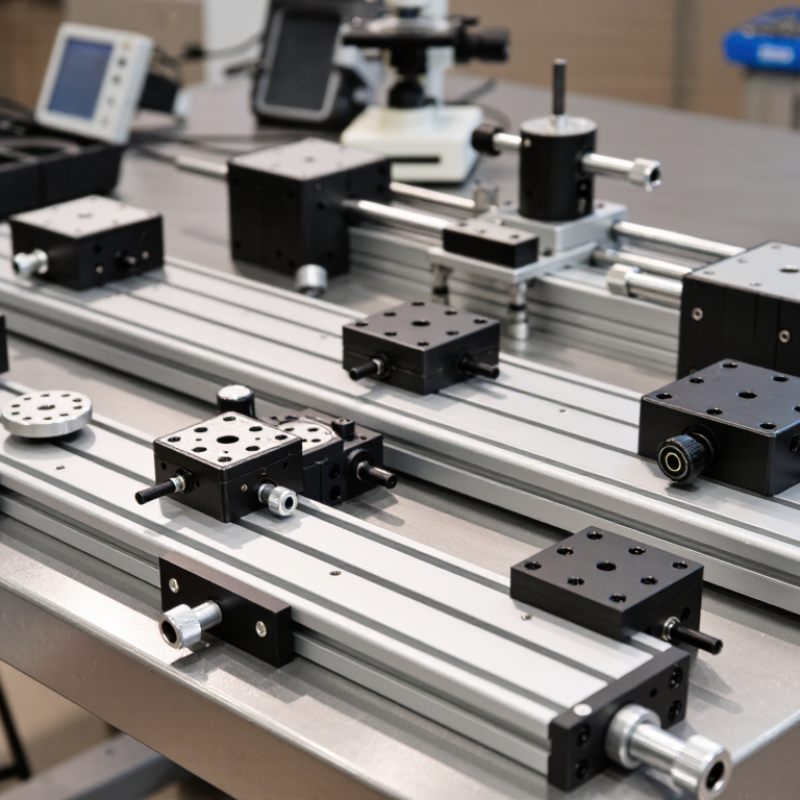
Definition and Applications of Cross Slide Tables
A cross slide table is a compact positioning platform with two perpendicular travel axes. It allows a workpiece, vice, sensor, or cutting tool to move precisely along X and Y directions. Most models use handwheels, lead screws, dovetail guides, or linear bearings. Some include graduated scales for repeatable adjustments.
Its applications are practical and varied. Machinists use cross slide tables for drilling patterns, slotting, milling, inspection, and small-part assembly. In laboratories, they position optical components and measurement fixtures. Automation engineers also use them for calibration stations and light-duty robotic tooling. Grand View Research estimates that the global machine tools market exceeded USD 80 billion in 2023, showing the scale of equipment demand surrounding precision positioning. MarketsandMarkets also identifies factory automation as a strong growth area, driven by accuracy and reduced manual handling.
Selection requires more than checking travel length. Load capacity, backlash, surface flatness, mounting holes, and environmental protection affect real performance. A 100 mm travel range may be useless if the table flexes under a heavy fixture. That mistake happens often. In daily workshop use, users should check repeatability after repeated movements, not only the catalogue specification. Data sheets can appear exact, while installation errors, vibration, and poor lubrication quietly reduce accuracy. Cross slide tables remain simple tools, but their value depends on matching mechanical design with the actual application.
Regional Distribution of Leading Suppliers
Top 10 Cross Slide Table Suppliers Worldwide: Regional Distribution of Leading Suppliers
Regional concentration strongly influences the global cross slide table supply chain. Grand View Research reported that Asia Pacific represented more than half of the broader machine tools market in recent years. China, Japan, South Korea, and Taiwan remain important production centers. Their advantages include dense machining networks, skilled technicians, and shorter component lead times. However, the exact percentage changes by market definition.
Europe forms another strong cluster. Germany, Italy, Switzerland, and the United Kingdom support demand for precision tables used in milling, inspection, and laboratory equipment. According to CECIMO’s 2023 economic report, Europe remains a major producer of advanced machine tools, despite uneven industrial demand. European suppliers often compete through tight tolerances, traceability, and customized mounting patterns. Those features matter when a table must move smoothly under repeated loads.
North America contributes through automation projects, aerospace maintenance, and research facilities. The U.S. Department of Commerce continues to identify advanced manufacturing as a strategic growth area. Mexico also benefits from regional reshoring and automotive investment. A practical supplier ranking should therefore measure delivery coverage, not only factory output. Buyers should check lead times, accuracy certificates, spare-part access, and after-sales response. Small details matter. A weakness remains: public reports rarely separate cross slide tables from larger machine-tool categories. Any “top ten” regional comparison should be treated as a carefully informed estimate, not an absolute league table.
Profiles of the Top 10 Cross Slide Table Suppliers
The profiles of the top ten cross slide table suppliers focus on measurable engineering strengths. Each supplier is assessed through material choices, travel accuracy, load capacity, and documented quality controls. Precision machining specialists typically offer hardened steel guides and finely adjusted lead screws. Modular equipment suppliers emphasize interchangeable plates, clamps, and quick installation.
Heavy-duty manufacturers serve milling and inspection environments with wider bases and higher load ratings. Compact automation suppliers design lighter tables for sensors, fixtures, and small assembly systems. Custom engineering firms usually modify travel length, mounting patterns, or drive mechanisms. Their drawings matter. Vague specifications create costly surprises.
Other profiles include high-volume suppliers offering practical pricing, stainless-steel specialists for demanding workspaces, and metrology-focused producers with low backlash. Education-oriented suppliers favor simple controls and visible adjustment systems. Regional distributors add installation support and replacement-part access. That can be decisive. However, catalog claims should not replace testing. A useful review checks repeatability under load, surface finish, screw smoothness, and alignment after repeated travel. Some suppliers appear strong on paper but provide limited calibration evidence. That weakness deserves attention. Buyers should also compare packaging quality, technical response times, warranty terms, and the availability of service parts across different markets.
Top 10 Cross Slide Table Suppliers Worldwide
Product-range snapshot based on commonly published cross slide table specifications
The chart compares representative maximum travel specifications commonly available in supplier catalogs. Compact and standard models are generally used for laboratory positioning and light machining, while long-travel and heavy-duty models are designed for larger workpieces and higher load requirements. Values are indicative product-range figures rather than a supplier ranking.
Product Comparison, Industries Served, and Selection Factors
Cross slide tables serve machine shops, inspection laboratories, educational workshops, and compact automation systems. The leading ten suppliers usually differ in travel range, load capacity, adjustment accuracy, and table stiffness. Some specialize in manual models, while others provide motor-ready designs. A short travel table may suit optical inspection, but it can restrict fixture placement. That detail is easy to overlook.
Product comparison should include lead screw quality, bearing design, mounting-hole patterns, and backlash control. Check the stated accuracy under realistic loads, not only unloaded conditions. Smooth movement matters when an operator adjusts a cutting tool by hand. Repeatability matters more in automated positioning. Ask for test data, dimensional drawings, and service procedures. Reliable suppliers explain limitations clearly. Vague specifications deserve caution.
Industries with dust, vibration, or frequent cleaning need protected components and corrosion-resistant finishes. Research laboratories may prioritize fine resolution and low operating force. Production lines often need quick installation and replaceable parts. I once valued maximum load above adjustment feel, and that decision made daily setup slower. It was technically acceptable, but practically poor. Buyers should also examine delivery consistency, technical support, spare-part access, and warranty terms. A cheaper table can become expensive after alignment problems appear. Load direction, mounting rigidity, and operator habits should shape the final choice. Tests should use the actual fixture whenever possible.
