Top 10 Water Irrigation Hose Types for Global Buyers
Choosing the right Water Irrigation Hose can influence water efficiency, crop health, labor time, and long-term operating costs. Global buyers face many options, including lay-flat hoses, drip lines, soaker hoses, reinforced PVC hoses, rubber hoses, and heavy-duty suction hoses. Each design serves a different irrigation condition. A greenhouse may need gentle, precise water delivery, while an open-field system may require high flow and strong abrasion resistance.
This guide examines the top 10 Water Irrigation Hose types for international purchasing decisions. It considers material quality, pressure ratings, flexibility, UV resistance, temperature tolerance, connector compatibility, and expected service life. Practical experience shows that a hose rated for high pressure may still fail when dragged across sharp stones or stored under intense sunlight. Small details matter. Wall thickness matters. Fittings matter too.
The comparison also reflects common buyer concerns, such as shipping volume, installation speed, maintenance access, and regional climate. Product data should be checked against manufacturer specifications and independent test information whenever possible. No shortlist is perfect. Soil conditions, water quality, pump performance, and local handling habits can change the best choice. Some recommendations may require adjustment after field testing. That is not a weakness; it is part of responsible sourcing. With clear technical criteria and realistic use conditions, buyers can reduce replacement costs and select irrigation hoses that perform reliably across farms, gardens, nurseries, and commercial growing operations.
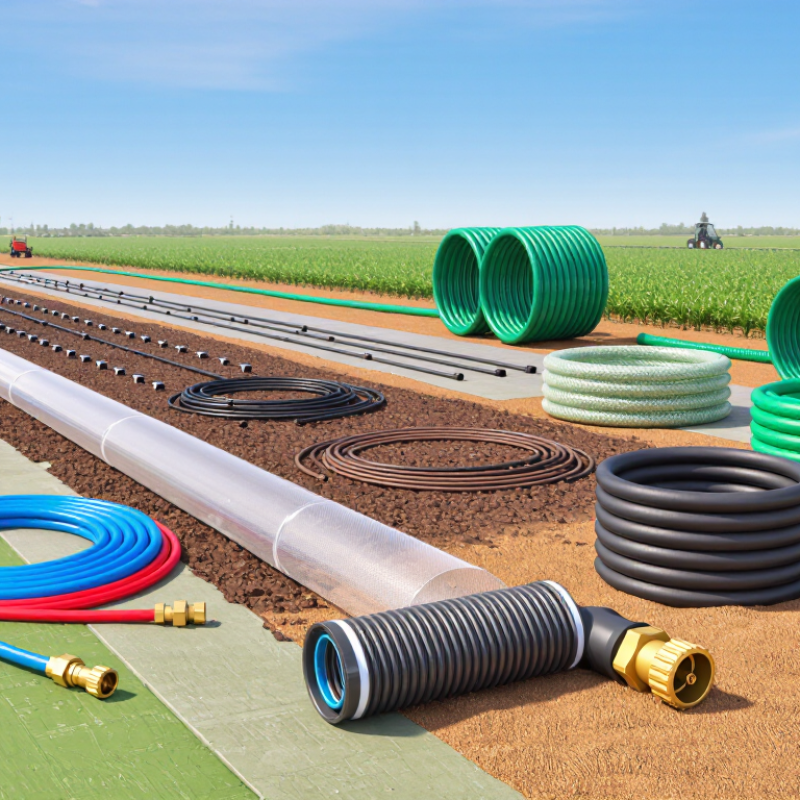
What Irrigation Hoses Are and How They Support Water Delivery
An irrigation hose is a flexible tube that moves water from a source to crops, lawns, nurseries, or greenhouse beds. It controls distance, pressure, and application speed.
Common types include drip hose, soaker hose, porous hose, lay-flat hose, reinforced PVC hose, rubber hose, polyethylene hose, micro-irrigation tubing, suction hose, and discharge hose. Each type supports a different delivery task. Drip and soaker hoses release water near plant roots, while lay-flat and discharge hoses move larger volumes across open fields.
Good water delivery depends on more than hose diameter. Buyers should check working pressure, temperature range, wall thickness, connector size, and resistance to ultraviolet exposure. A 25-metre hose may serve a small vegetable bed, but a longer run can lose pressure and water unevenly. Sharp bends also restrict flow.
A simple field test helps: measure the outlet flow, inspect leaks, and watch whether distant plants receive enough water.
Global buyers should request material details, test records, and clear installation guidance. Food-contact or potable-water use may require different compliance documents than agricultural irrigation.
Storage matters too. Drain the hose, keep it away from direct sunlight, and avoid dragging it over rough concrete. No hose is perfect. A strong outer layer can still hide poor flexibility, and an affordable hose may need more frequent replacement. Real crop conditions should guide the final choice.
The Ten Main Irrigation Hose Types and Their Core Characteristics
Top 10 Water Irrigation Hose Types for Global Buyers
The Ten Main Irrigation Hose Types and Their Core Characteristics
Global irrigation choices should reflect pressure, crop spacing, soil, and climate. FAO AQUASTAT reports that agriculture accounts for about 70% of global freshwater withdrawals. Hose selection therefore influences operating costs and water stewardship. The ten main types include lay-flat, drip, soaker, sprinkler, porous, rain, micro-irrigation, suction, discharge, and reinforced PVC hose. Lay-flat hose stores easily and suits temporary lines. Drip hose delivers measured water beside plant roots. Soaker hose wets continuous soil bands. Sprinkler hose covers wider areas with spray. Porous hose releases water through its wall. Rain hose produces gentle droplets for garden beds. Micro-irrigation hose supports low-flow emitters. Suction hose resists collapse during intake. Discharge hose moves water under pressure. Reinforced PVC hose offers abrasion resistance and dimensional stability.
No hose is ideal. Field experience proves this repeatedly. Drip systems can clog when filtration is weak. Soaker hoses may overwater downhill beds. Lay-flat tubing can kink near sharp valves. The UN World Water Development Report 2024 identifies agriculture as the largest global freshwater user. That finding makes maintenance especially important. Buyers should verify burst pressure, UV resistance, temperature range, wall thickness, connector fit, and repair access. Real fields disagree. A technically efficient hose may still waste water when installed poorly. Soil testing and pressure checks should guide the final choice.
Top 10 Water Irrigation Hose Types for Global Buyers
The chart compares representative typical working-pressure ranges for ten widely used irrigation hose types. Actual pressure ratings vary according to material, wall thickness, diameter, fittings, temperature, and manufacturer specifications.
| Hose Type | Core Characteristic |
| Drip Tape | Thin-wall, seasonal crop irrigation with integrated emitters. |
| Porous Soaker Hose | Permeable wall releases water gradually along planting beds. |
| Pressure-Compensating Dripline | Built-in emitters help maintain uniform flow across uneven terrain. |
| Micro-Tube | Small flexible tube used for container plants and localized delivery. |
| Sprinkler Hose | Perforations distribute water as a low-pressure spray or mist. |
| Polyethylene Layflat Hose | Lightweight, flexible water-transfer hose for temporary field layouts. |
| PVC Reinforced Hose | Braided reinforcement improves pressure resistance and dimensional stability. |
| PU Layflat Hose | Abrasion-resistant and flexible option for pumping and temporary transfer. |
| Rubber Irrigation Hose | Durable and flexible, suited to repeated handling and demanding environments. |
| Suction and Discharge Hose | Designed for pump intake or discharge, commonly with a rigid helix for suction service. |
Which Irrigation Hose Fits Different Crops, Climates, and Farm Systems
Top 10 Water Irrigation Hose Types for Global Buyers
Which Irrigation Hose Fits Different Crops, Climates, and Farm Systems
Choosing an irrigation hose starts with the crop, not the catalogue. Dripline delivers water beside tomato, pepper, and cucumber roots. Drip tape suits seasonal vegetables and flat planting beds. Micro-tubing works well in greenhouse pots and nursery containers. Soaker hose provides gentle moisture for flower borders and shallow-rooted crops. Use it carefully on heavy clay soils. Water may spread unevenly.
Climate changes the decision. In hot, sunny regions, reinforced PVC and UV-resistant layflat hose tolerate frequent outdoor use. Layflat hose also suits pumps, filters, and long field runs. In windy areas, sprinkler hose needs stable pressure and secure connections. Porous hose can reduce surface disturbance, but it may clog when water contains fine sediment. Clean filtration matters. It is often overlooked.
Farm layout matters just as much. Suction hose connects a water source to a pump, while discharge hose carries water toward storage tanks or fields. High-pressure spray hose fits orchards and larger vegetable areas with suitable sprinklers. Lightweight garden hose helps small plots, but it may kink during daily movement. I have seen growers choose a cheaper hose, then replace it after one harsh season. That experience is useful, but not universal. Test pressure, temperature, soil texture, and connector fit before expanding the system.
Global Buying Factors: Standards, Compatibility, Shipping, and Maintenance
Global irrigation hose purchasing starts with standards, not color or advertised flow. FAO AQUASTAT reports that agriculture accounts for roughly 70% of global freshwater withdrawals. A weak hose can waste water and increase replacement costs. Buyers should request pressure ratings, burst-test results, dimensional tolerances, and material declarations. ISO 1307 addresses hose dimensions, while ISO 1402 covers hydrostatic pressure testing. Local requirements may still differ.
Compatibility deserves a physical check. Match the hose inner diameter with pumps, valves, and connectors before placing a bulk order. Consider water temperature, fertilizer concentration, ultraviolet exposure, and soil abrasion. PVC, rubber, and thermoplastic hoses behave differently in cold weather. A small mismatch can create leaks. It happens more often than catalogs suggest. I would also test one sample under actual pressure before approving a container shipment.
Shipping calculations should include coil diameter, pallet height, gross weight, and moisture protection. UNCTAD reports that maritime transport carries over 80% of world merchandise trade by volume, so port delays can affect seasonal irrigation schedules. Confirm the HS classification and packaging limits with the customs broker. During storage, drain hoses completely, keep them shaded, and avoid sharp bends. Inspect couplings for cracks after every work cycle. Standards reduce uncertainty, but they do not replace field inspection.
