
Request A Quote

Phone: 416-244-6476
Email:

    Top Road Marking Machine Manufacturers Worldwide

    Choosing among the top Road Marking Machine manufacturers worldwide requires more than comparing prices or glossy product images. Road contractors need equipment that performs consistently on highways, airport aprons, urban streets, and uneven local roads. A machine may look impressive in a showroom. Field conditions reveal more.

    This guide examines manufacturers through practical and measurable criteria. These include spray accuracy, thermoplastic handling, glass bead distribution, operating speed, fuel efficiency, maintenance access, and operator safety. It also considers manufacturing experience, technical support, spare-parts availability, and documented quality practices. Those details matter when a machine works beside moving traffic or during a narrow overnight closure.

    Real experience should influence every assessment. Contractors often notice small weaknesses first: a clogged spray tip, an unstable pressure gauge, or controls that are difficult to read in rain. These problems can waste material and delay road opening. Still, no ranking is perfect. Product specifications change, regional distributors vary, and independent performance data is not always easy to verify. That limitation deserves attention.

    Reliable manufacturers usually explain their application ranges clearly. They provide manuals, training, maintenance guidance, and responsive after-sales service. Professional buyers should also inspect demonstration results and speak with long-term users. A strong reputation helps, but it cannot replace evidence. The best choice depends on road design, marking material, project volume, climate, and available technicians. This overview offers a practical starting point for comparing leading global manufacturers with greater confidence and fewer assumptions.
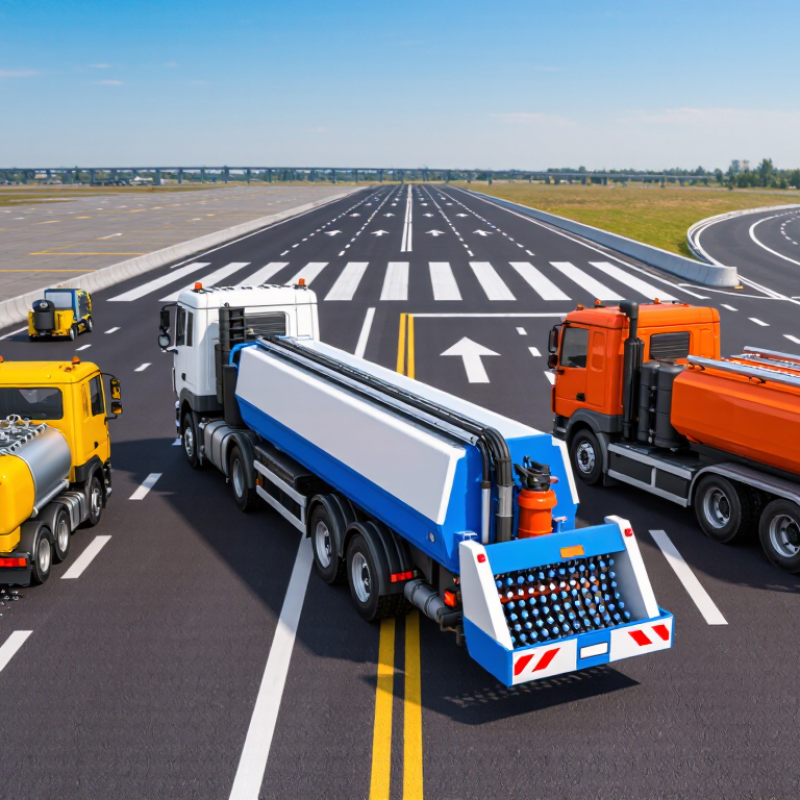
    Top Road Marking Machine Manufacturers Worldwide

    Road Marking Machines: Functions, Types, and Core Operating Principles

    Top Road Marking Machine Manufacturers Worldwide

    Road marking machines apply paint, thermoplastic, or two-component resin with controlled pressure and speed. Their main functions include line forming, bead spreading, cleaning, and material temperature control. Airless sprayers create sharp edges with high-pressure fluid. Pneumatic systems use compressed air for softer lines and smaller projects. Thermoplastic machines melt solid material inside a heated kettle, often near 180–220°C.

    Common formats include walk-behind units, ride-on machines, truck-mounted systems, and robotic platforms. Walk-behind models suit parking spaces and short repairs. Ride-on machines reduce operator fatigue on long roads. Truck-mounted equipment supports highways, multiple guns, and large glass-bead tanks. A compact machine may deliver roughly 2–4 litres per minute, while larger systems exceed 10 litres per minute, depending on viscosity and nozzle size.

    Control matters more than appearance. Operators adjust pump pressure, nozzle width, travel speed, and bead flow together. A small speed change can produce visibly uneven lines. The MarketsandMarkets Road Marking Materials Market report projects growth from about USD 6.8 billion in 2023 to USD 9.5 billion by 2028, increasing demand for compatible application equipment. The U.S. Federal Highway Administration also stresses consistent visibility, retroreflectivity, and proper surface preparation in its pavement-marking guidance. Field practice remains imperfect. Dust, moisture, and rushed calibration still reduce durability. A reliable setup checks surface temperature, tests a short section, and measures wet-film thickness before full application.

    Key Specifications: 1.5–3 mm Thickness, 100–150 mm Line Widths, and 0.5–15 km/h

    Top Road Marking Machine Manufacturers Worldwide

    Professional buyers usually begin with three numbers: 1.5–3 mm coating thickness, 100–150 mm line width, and 0.5–15 km/h operating speed. These figures define more than output. They affect material use, drying time, edge sharpness, and worker control. The FHWA Manual on Uniform Traffic Control Devices, 11th Edition, identifies 100 mm as a common minimum width for pavement markings in the United States. Therefore, machines should maintain stable lines near this baseline, not merely advertise maximum width.

    A 1.5–3 mm application range supports different road paints and thermoplastic systems. Thicker layers may improve visibility, but they also demand stronger heating control and consistent surface preparation. At 0.5 km/h, operators can manage junctions, arrows, and short repairs with greater precision. At 15 km/h, production rises, yet uneven surfaces can expose poor flow control. Speed is not everything.

    Field tests often reveal the gap.

    Technical reports from FHWA and European road-marking performance guidance, including EN 1436, emphasize visibility, retroreflection, durability, and skid resistance rather than machine speed alone. Buyers should check pump accuracy, bead distribution, nozzle adjustment, and cleaning access. A 150 mm line may look efficient, but unstable pressure can create ragged edges. That detail is easy to miss. Manufacturers with strong engineering records usually publish calibrated output data, test conditions, and maintenance intervals. Without those details, specification tables remain incomplete and deserve careful review.

    Application Technologies: Paint, Thermoplastic, Cold Plastic, and Spray Systems

    Top Road Marking Machine Manufacturers Worldwide

    Application Technologies: Paint, Thermoplastic, Cold Plastic, and Spray Systems

    Road marking machines now support several application technologies, each suited to different traffic and climate conditions. Water-based and solvent-based paint systems offer fast application and lower initial costs. They work well for temporary layouts, urban lanes, and frequent maintenance. However, paint can wear quickly under heavy tires, standing water, and abrasive winter treatment. Dry film matters.

    Thermoplastic systems apply heated material through extrusion or screed units. Their thicker film improves durability and nighttime visibility when glass beads are embedded correctly. Field teams often operate near 180–220°C, so temperature control is critical. Cold plastic uses reactive resin without extensive heating. It provides strong thickness and chemical resistance, especially at junctions, arrows, and cycle lanes. Application errors remain common. Poor mixing can shorten service life.

    Spray systems improve speed on long road sections and complex symbols. They also reduce material waste when pressure, nozzle size, and travel speed are calibrated together. Allied Market Research valued the global road marking materials market at about 6 billion dollars in 2021 and forecast it to exceed 9 billion dollars by 2031. The WHO Global Status Report on Road Safety 2023 recorded approximately 1.19 million annual road deaths, reinforcing the importance of visible markings. Yet material choice alone cannot ensure safety. Surface moisture, bead retention, curing time, and operator training often decide real-world performance.

    Leading Manufacturers by Region: Europe, North America, and Asia-Pacific

    Top Road Marking Machine Manufacturers Worldwide

    Europe’s leading road marking machine manufacturers focus on precision, low emissions, and strict work-zone control. Equipment commonly supports thermoplastic, cold plastic, and waterborne materials. The European Commission’s Road Safety Statistics 2023 reported more than 20,000 road deaths across the European Union in 2022. Clear markings remain essential for lane guidance, especially during night driving and wet conditions. On-site experience shows that heating stability often matters more than headline engine power. Small errors become visible quickly.

    North American manufacturers typically emphasize productivity, operator visibility, and compatibility with detailed highway specifications. The Federal Highway Administration’s 2023 National Roadway Safety Strategy highlights roadway design and visibility as important safety factors. Market reports from MarketsandMarkets estimate steady global growth for road marking machines through the late 2020s, with replacement demand supporting mature markets. Yet productivity claims require caution. A faster machine is not automatically better when material curing, bead distribution, or cleaning time is ignored.

    Asia-Pacific manufacturers serve highly varied conditions, from dense urban roads to remote highways. The Asian Development Bank has projected continued infrastructure investment across developing Asian economies, supporting demand for durable marking equipment. Regional buyers often prioritize compact dimensions, simple maintenance, and flexible fuel or power options. Grand View Research also identifies Asia-Pacific as a strong growth region for road construction equipment. However, published forecasts differ considerably. Buyers should verify local climate testing, spare-parts access, training quality, and compliance documentation before selecting a manufacturer.

    Evaluation Criteria: Output Rate, Precision, Emissions, Safety, and Service Support

    Top Road Marking Machine Manufacturers Worldwide

    Choosing a road marking machine requires more than comparing advertised speed. Output rate should match crew size, material type, and daily road closures. A reliable machine can maintain steady flow without frequent cleaning or nozzle replacement. Precision matters equally. Look for stable pressure control, accurate line width, and consistent bead distribution. A small deviation can become obvious across several kilometres.

    Emissions and safety deserve practical testing. Electric or low-emission systems may reduce fumes in enclosed areas and busy streets. Check noise levels, emergency stops, guarding, and operator visibility. Service support is often overlooked. Ask about spare parts, technician response times, training, and maintenance records. Real project experience matters more than polished specifications. Some machines perform well in demonstrations but struggle with uneven surfaces, cold paint, or long shifts.

    Tips: Request a live trial using your actual coating and road texture. Measure output rate, line accuracy, cleanup time, and fuel or battery use. Record results, including failures. A machine that needs constant adjustment may cost more than expected. Also inspect the control panel with gloves on. Small usability problems can become serious during night work. Do not rely on one impressive test run; repeat the evaluation under changing conditions.

    Top Road Marking Machine Manufacturers Worldwide - Evaluation Criteria: Output Rate, Precision, Emissions, Safety, and Service Support
    Indicative industry benchmarks for comparing road marking machine manufacturers. Actual results depend on material, line width, surface condition, operator skill, climate, and machine configuration.
    Evaluation Dimension Measurable Indicator Strong Performance Benchmark Recommended Verification Method Priority
    Output Rate Application speed and usable line length per hour Approximately 1–5 km/h of continuous application speed for common spray or screed operations, with limited downtime for refilling and cleaning Conduct a timed field test using the same line width, material, pressure, surface, and refill conditions Critical
    Material Throughput Pump, spray, or extrusion capacity in L/min or kg/min Stable flow across the specified operating range without pulsation, excessive overspray, or frequent nozzle blockage Compare manufacturer test data with an independent volume or mass measurement during continuous operation Critical
    Line-Width Precision Difference between specified and actual line width Typical well-adjusted equipment can target approximately ±5–10 mm under controlled conditions, depending on material and application method Measure multiple points with a calibrated rule or digital gauge after the coating has stabilized Critical
    Line Straightness Lateral deviation over a defined test distance Consistent tracking with minimal drift, supported by adjustable steering, stable chassis geometry, and optional guidance technology Test a straight line over at least 50–100 m and calculate the maximum lateral deviation High
    Bead and Reflective-Glass Distribution Uniformity of drop-on or premixed reflective material Consistent distribution across the full line with adjustable dosing and minimal overspray or missed areas Collect and weigh samples from multiple line sections; inspect distribution visually and photographically High
    Emissions Tailpipe emissions, fuel consumption, and coating-related VOC exposure Battery-electric machines produce zero tailpipe emissions during operation; combustion-powered units should comply with the applicable EU Stage V or U.S. EPA Tier 4 Final requirements Review engine certification, measure fuel or energy use, and verify coating safety data sheets and ventilation requirements Critical
    Operator Safety Emergency controls, guarding, visibility, stability, and chemical handling Emergency stop, dead-man control, guarded moving parts, stable braking, high-visibility lighting, reverse warning, and clear pressure-release procedures Review the risk assessment and user manual against ISO 12100 principles and applicable local machinery regulations Critical
    Changeover and Cleaning Time required to change colors, materials, or line configurations Tool-light access to filters, hoses, guns, and nozzles, with documented flushing procedures and low material waste Record changeover time, cleaning-agent consumption, waste volume, and number of tools required High
    Surface and Material Compatibility Compatibility with waterborne paint, solvent-based paint, thermoplastic, cold plastic, or two-component systems Clearly documented compatibility, suitable pressure and heating controls, and application settings for each approved material type Check technical documentation and perform a controlled trial on representative asphalt or concrete surfaces High
    Service and Spare Parts Support Parts availability, technical response, training, warranty, and repair capability Published parts lists, service manuals, trained technicians, regional support, defined warranty terms, and documented response targets Request service-level terms, average parts lead times, training records, warranty exclusions, and customer references Critical
    Compliance and Documentation Declarations, manuals, test records, and applicable regional certifications Complete operating and maintenance manuals, conformity documentation, safety instructions, and transparent performance data Audit the document package and confirm requirements for the destination market before purchase High
    Lifecycle Cost Purchase price, consumables, energy or fuel, maintenance, downtime, and resale value Competitive total cost per marked kilometer rather than the lowest initial purchase price Build a five-year total-cost model using expected operating hours, maintenance intervals, consumables, and local labor rates High