
Request A Quote

Phone: 416-244-6476
Email:

    China Best Spring Tensioner Manufacturer Supplier?

    Choosing the China best Spring Tensioner manufacturer supplier requires more than comparing prices or product photos. A dependable supplier should understand load cycles, installation space, corrosion exposure, and the consequences of spring fatigue. Dr. Robert L. Norton, a respected mechanical-design author, wrote, “The function of a spring is to store energy and release it when required.” That simple principle remains highly practical for tensioner selection.

    A qualified Chinese manufacturer should provide material details, dimensional tolerances, cycle-testing records, and traceable inspection reports. Look for experience with carbon steel, stainless steel, and customized spring assemblies. Ask how the supplier controls wire diameter, coil pitch, preload, and surface treatment. Small variations can create noise, belt slip, premature wear, or unexpected tension loss.

    Factory experience matters. A supplier that tests samples under realistic temperatures and repeated movement offers stronger evidence than one relying only on certificates. Photographs of CNC equipment are not enough. Request drawings, samples, test methods, and production references.

    The ideal Spring Tensioner supplier also communicates clearly. Engineering feedback should be specific, not vague. Delivery promises should match actual capacity. This part is sometimes overlooked.

    No supplier is perfect. Even a well-designed tensioner may fail when the operating conditions change. Therefore, buyers should review the complete assembly, not only the spring. China offers many capable manufacturers, but the best choice depends on verified engineering ability, consistent quality, transparent documentation, and dependable after-sales support.
    China Best Spring Tensioner Manufacturer Supplier?

    What Is a Spring Tensioner and How Does It Work?

    A spring tensioner is a mechanical device that keeps steady tension on a belt, chain, cable, or moving assembly. It usually combines a spring, an arm, and a pulley or contact point. As the system moves, the spring pushes the arm against the working part. This compensates for vibration, thermal expansion, and gradual wear.

    In practical maintenance, correct tension matters. Too little tension may cause slipping, noise, or unstable motion. Too much tension can overload bearings and shorten belt life. The tensioner works by storing spring energy and releasing it as resistance changes. Its movement should remain smooth, without sudden jumps or grinding sounds. A small design detail can matter greatly. I have found that installation angles are sometimes underestimated. They can affect the actual force.

    Tips: Check alignment before adjusting tension. Inspect the spring for cracks or corrosion. Rotate the pulley by hand and listen carefully. Replace damaged parts instead of forcing them back into service. Use measured tension whenever possible, because visual judgment is not always reliable. Selection should consider load, temperature, cycle frequency, and available space. A supplier with documented testing, consistent materials, and clear technical data is a safer choice. Even experienced technicians can miss early wear. That is worth remembering.

    Types of Spring Tensioners Manufactured in China

    China Best Spring Tensioner Manufacturer Supplier?

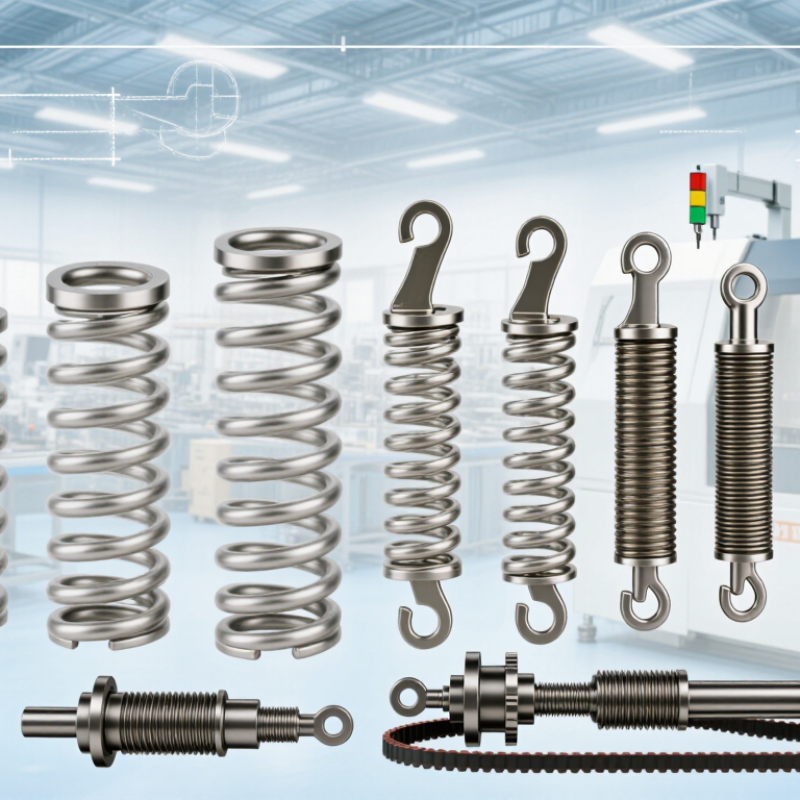
    China manufactures several spring tensioner types for conveyors, engines, chains, and automated equipment. Coil spring tensioners provide steady radial force around pulleys. Torsion spring tensioners suit compact assemblies with controlled angular movement. Compression spring tensioners handle short-stroke loading, while constant-force designs support longer travel. Hydraulic-assisted spring tensioners combine mechanical preload with damping for vibration-prone machinery. Each type needs correct wire diameter, spring rate, travel, and corrosion protection. Small errors matter.

    In practical sourcing, engineers should request load-deflection curves, fatigue-cycle results, material certificates, and dimensional inspection records. Stainless steel suits humid production lines, while alloy spring steel supports higher repeated loads. According to the U.S. Department of Energy’s Industrial Decarbonization Roadmap, motor-driven systems represent about 69% of industrial electricity use. Efficient tensioning can reduce belt slip, heat, and avoidable maintenance in these systems. The International Energy Agency reported that industry consumed roughly 37% of global final energy in 2022, making reliable mechanical transmission increasingly important. However, spring tension alone cannot solve poor alignment. That assumption deserves review. A credible Chinese supplier should verify prototypes under temperature, vibration, and repeated-cycle conditions, not only provide attractive catalog figures. Bulk production should include batch traceability and sample retention. Cheap is not always economical.

    Key Applications Across Industrial and Automotive Systems

    China Best Spring Tensioner Manufacturer Supplier?

    Spring tensioners maintain controlled force in belt, chain, and guide systems. In automotive engines, they support timing drives, accessory belts, and compact cooling assemblies. OICA reported 93.5 million motor vehicles were produced worldwide in 2023. This volume increases demand for consistent tension, low noise, and long service life.

    Industrial applications are broader. Conveyors, packaging lines, pumps, compressors, and material-handling equipment rely on tensioners to reduce belt slip. The U.S. Department of Energy notes that poorly maintained belt-drive systems can waste substantial energy through friction and misalignment. A correctly designed spring tensioner helps stabilize contact pressure during speed changes. It also compensates for normal belt elongation.

    Real-world sourcing requires more than a catalog load rating. A capable Chinese manufacturer should provide spring-force curves, fatigue-test results, corrosion data, and dimensional inspection records. Materials must match temperature, vibration, and chemical exposure. In automotive systems, the IEA reported nearly 14 million electric cars were sold globally in 2023. Their compact thermal and auxiliary systems create new packaging challenges, even when traditional engine layouts disappear.

    Small details matter.

    Thread quality, pivot friction, and assembly preload can change performance. Some suppliers focus too heavily on low price. That is a mistake. My own view is less certain: laboratory testing cannot fully reproduce dust, heat cycles, and careless installation. Field feedback remains essential. Reliable suppliers should welcome design reviews, sample testing, and traceable production records.

    How China Manufacturers Control Quality and Production

    China’s spring tensioner manufacturers face strict demands for stable force, fatigue resistance, and dimensional accuracy. The China Association of Automobile Manufacturers reported 31.28 million vehicles produced in 2024. This volume increases pressure on component suppliers. A reliable factory should verify wire diameter, coil diameter, free length, and load at defined heights for every production lot.

    Material control starts with certified spring steel and heat-treatment records. The World Steel Association reported China produced about 1.005 billion tonnes of crude steel in 2024. Large output does not automatically mean consistent quality. Manufacturers must still check chemical composition, tensile strength, hardness, and surface defects. Many experienced plants use incoming inspection, furnace temperature records, and batch traceability. Each carton should link to a material certificate and inspection report.

    Production control needs more than a final visual check. CNC forming equipment should record setup parameters, while calibrated load testers verify spring performance. Sampling plans can follow ISO 2859-1, but critical safety dimensions may require 100% inspection. This is where some factories still fall short. A perfect batch is a claim, not evidence. Independent audits, capability studies, and fatigue testing provide stronger proof. In practice, small errors often begin with rushed tooling changes or incomplete records. Suppliers should disclose these weaknesses and correct them, rather than hiding them behind polished samples.

    How to Select a Reliable Spring Tensioner Supplier in China

    China Best Spring Tensioner Manufacturer Supplier?

    How to Select a Reliable Spring Tensioner Supplier in China

    Selecting a reliable spring tensioner supplier requires more than comparing prices. Check the supplier’s experience with your application, such as conveyor systems, engines, or industrial machinery. Request material certificates, load testing records, and dimensional inspection reports. A capable manufacturer should explain spring rate, working stroke, fatigue life, and surface treatment clearly. Ask for samples before approving mass production. Measure the sample under real operating conditions. Small differences can affect tension stability.

    Communication also reveals technical reliability. The supplier should answer drawings, tolerances, packaging, and delivery questions with specific details. Confirm whether production records can trace raw materials and inspection results. Visit the factory when possible, or request a live production video. However, photographs are not proof of current capacity. This is often overlooked. A clear quality agreement can prevent arguments later, especially about rejected parts and replacement terms.

    Tips: Compare at least three qualified suppliers. Check certificates independently. Test samples for noise, corrosion, and repeated loading. Do not select the lowest quotation automatically. A cheaper spring tensioner may use inconsistent wire diameter or weak protective coating. Ask for a realistic lead time, not an attractive promise. Keep written records of every technical change. Some buyers skip this step, then regret it.

    How to Select a Reliable Spring Tensioner Supplier in China

    A practical supplier qualification scorecard can help buyers compare manufacturers using measurable evidence such as quality systems, material traceability, testing capability, corrosion validation, dimensional control, and delivery management.

    The weighting below is an example procurement framework. Buyers should adjust the percentages according to the tensioner’s load, operating environment, compliance requirements, and delivery risk.