Why Choose an Aluminum Fin Press Machine?
Choosing the right equipment can determine whether fin production remains stable or becomes a costly bottleneck. An Aluminum Fin Press Machine is designed to form precise fins from aluminum strip, supporting heat exchangers, radiators, condensers, and other thermal components. Its value comes from controlled feeding, repeatable stamping, and consistent fin geometry. Small deviations can affect airflow, assembly accuracy, and final heat-transfer performance.
In practical production, operators often notice the difference at the cutting station first. A reliable machine keeps the strip aligned, maintains steady pitch, and reduces burrs around each fin. That matters. Stable motion also helps limit material waste and unplanned adjustments. Experienced technicians usually evaluate press force, stroke rate, tooling access, coil compatibility, and changeover time before purchase. They also inspect guarding, emergency stops, noise levels, and maintenance access. These details support safer and more dependable operation.
However, an Aluminum Fin Press Machine is not a universal solution. Excessive speed may reduce quality when tooling is poorly matched or aluminum thickness changes. Even advanced equipment requires trained operators, scheduled lubrication, accurate die setup, and regular inspections. This is where many buying decisions need reflection. A lower purchase price may hide slower changeovers or expensive replacement tooling. Buyers should request sample production, measured tolerances, service records, and realistic output data. A manufacturer that explains limitations clearly is often more trustworthy than one promising perfect results. The best choice balances productivity, precision, safety, energy use, and long-term technical support.
What Is an Aluminum Fin Press Machine?
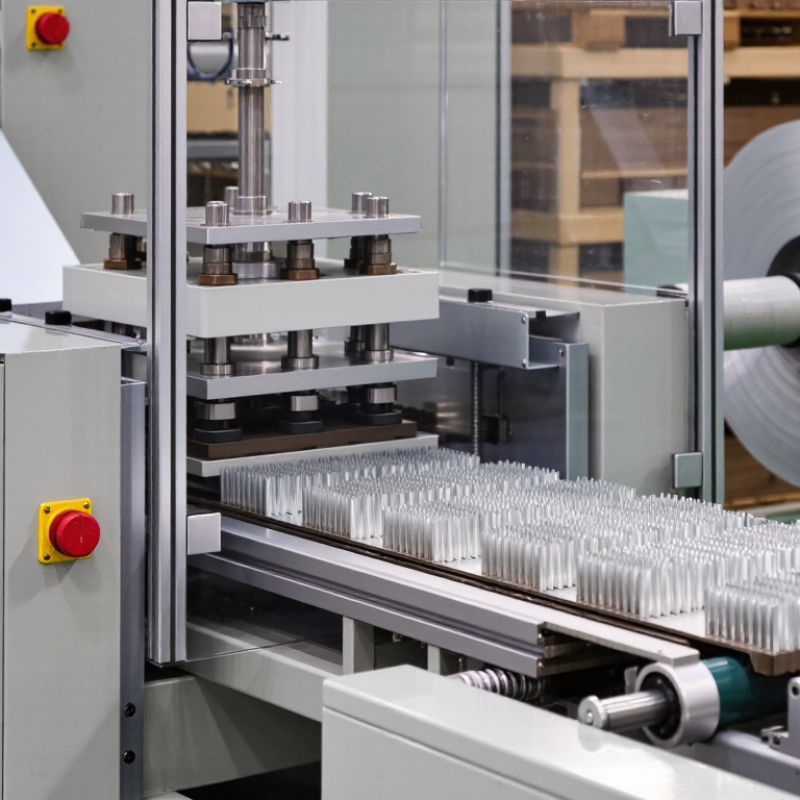
An aluminum fin press machine is a forming system that converts thin aluminum strip into heat-transfer fins. The strip passes through a progressive die, where rollers or punches create louvers, corrugations, collars, or stamped profiles. A feeder controls the material length, while the press applies repeated, measured force. The finished fins are then assembled into heat exchangers, radiators, evaporators, and air-conditioning coils.
Its value comes from repeatability rather than simple speed. In production, engineers monitor stroke rate, strip tension, die clearance, fin height, and burr formation. A small clearance error can deform the fin edge or restrict airflow. The International Aluminium Institute reports that about 75% of all aluminum ever produced remains in use today, showing the material’s long service life and recovery potential. The U.S. Department of Energy also notes that recycled aluminum requires roughly 5% of the energy used for primary aluminum production.
The machine must match the alloy, thickness, and fin geometry. That sounds obvious. It is often missed. A high-speed press may increase output, yet poor lubrication or worn tooling can raise scrap rates quickly. In practical trials, operators should check pitch accuracy, springback, surface marks, and coil stability before full production. Published industry figures can guide decisions, but factory results still depend on tooling design, maintenance, and operator experience. One uncomfortable point remains: the press alone cannot guarantee efficient heat transfer. fin spacing and assembly quality matter just as much.
Key Advantages of Aluminum Fin Press Technology
Why Choose an Aluminum Fin Press Machine?
Key Advantages of Aluminum Fin Press Technology
Aluminum fin press technology creates consistent, thin fins at production speed. It forms coil material through controlled feeding, stamping, and progressive tooling. This process supports repeatable fin height, pitch, and spacing. Small dimensional changes matter. They affect airflow and heat transfer.
Aluminum also offers strong thermal performance at a low weight. The U.S. Department of Energy identifies aluminum as a common heat-exchanger material because of its thermal conductivity and formability. According to the Aluminum Association, recycled aluminum requires about 95% less energy than primary aluminum production. Efficient fin pressing can reduce scrap through accurate nesting and stable feed control. The result is less material waste and more predictable costs.
Production data still requires careful interpretation. A faster press does not automatically create better fins. Tool wear, burr formation, and uneven coil tension can reduce quality. Operators need inspection plans, lubrication control, and scheduled die maintenance. The International Aluminium Institute reports that roughly 75% of aluminum ever produced remains in use today, supporting aluminum’s long service life and recycling value. Yet, the machine setup must match alloy temper and fin thickness. That detail is easy to overlook.
Why Choose an Aluminum Fin Press Machine?
Aluminum 3003 combines low density with high thermal conductivity, making it well suited for lightweight, efficient heat-exchanger fins. Its excellent formability also supports high-speed pressing and precise fin geometries. Values shown are representative room-temperature engineering data and may vary by alloy, temper, and processing conditions.
Important Features and Selection Criteria
Why Choose an Aluminum Fin Press Machine?
An aluminum fin press machine can produce consistent fins for heat exchangers, radiators, and cooling systems. Its value depends on more than maximum pressing force. Stroke length, operating speed, and die compatibility must match the fin design. Thin aluminum strips require controlled feeding. Small errors can create uneven spacing or damaged edges.
A reliable machine should offer rigid construction, low vibration, and accurate servo or mechanical control. Check the press tolerance under continuous operation, not only during a short demonstration. Automatic lubrication can reduce wear around moving components. A clear control panel also helps operators adjust feed length, stroke rate, and emergency settings safely. Guarding, interlocks, and accessible maintenance points are essential selection criteria.
Production experience shows that material handling often causes more trouble than the press itself. Inspect the decoiler, straightener, feeder, and scrap collection system as one line. Ask for measured noise, energy use, repeatability, and maintenance records. A machine with excessive speed may reduce quality when aluminum is soft or unusually thin. That detail is easy to overlook. Some buyers focus on output numbers and regret ignoring tooling changes. The best choice balances capacity, precision, operator safety, replacement parts, and long-term service support. No specification sheet tells the whole story. Test your actual aluminum coil before making a final decision.
Applications, Maintenance, and Safety Considerations
Aluminum fin press machines suit heat exchangers, radiators, evaporators, and ventilation equipment. Their controlled forming action produces consistent fins with minimal material waste. The International Aluminium Institute projects global aluminum demand could rise by 80% by 2050. That growth will increase pressure for efficient, repeatable forming processes. In practice, operators should match die geometry, strip thickness, and feed speed carefully. Small mismatches can create torn fins, uneven pitch, or unnecessary scrap.
Maintenance begins with observation. Check guide rails, punches, dies, and feed rollers at every shift. Remove aluminum chips before they harden around moving parts. Lubrication must follow the machine maker’s specified grade and interval. Excess lubricant can contaminate fins. Insufficient lubricant increases friction and heat. The U.S. Department of Energy reports that motor-driven systems consume about 23% of industrial electricity in the United States. A poorly adjusted press may therefore waste more energy than expected. Measure cycle energy when possible. Numbers expose assumptions.
Safety controls deserve equal attention. Install guarding around the die area and keep hands outside the point of operation. OSHA’s machine-guarding rule, 29 CFR 1910.212, requires protection from hazards such as nip points and rotating components. Lockout/tagout under 29 CFR 1910.147 is necessary before clearing jams or servicing dies. Use eye protection, hearing protection, and cut-resistant gloves during appropriate tasks. Gloves near moving tooling can create risks, however. That detail is easy to overlook. Train operators with real jam scenarios, not only written instructions, and review near misses without blaming individuals.
