Why Choose a Barn Door Slab for Your Home?
Choosing a Barn Door Slab can change how a room feels without changing its footprint. It slides beside the wall, leaving the floor clear for a narrow hallway, a laundry basket, or a small bedside table. Its visible wood grain can also become part of the room’s design. But the choice is not automatically right for every home.
Houzz’s 2024 U.S. Houzz & Home Study reported that 54% of surveyed homeowners renovated in 2023, with median renovation spending of $24,000. That broader remodeling context shows why practical, considered upgrades matter. It does not measure barn-door demand, performance, or savings, so it should not be read as proof that a Barn Door Slab increases home value. Check the opening, wall space, privacy needs, and hardware before choosing one. A slab also will not provide the same sound control as many hinged doors.
A reliable introduction should not invent expert testimony. The materials provided contain no verifiable name or direct quotation from a Barn Door Slab specialist, so I cannot responsibly attribute a quote. That limitation matters. A beautiful door can still disappoint if it blocks a switch, leaves an unwanted gap, or feels too heavy for its track. The best choice balances appearance with everyday use—and admits that some rooms simply need a different door.
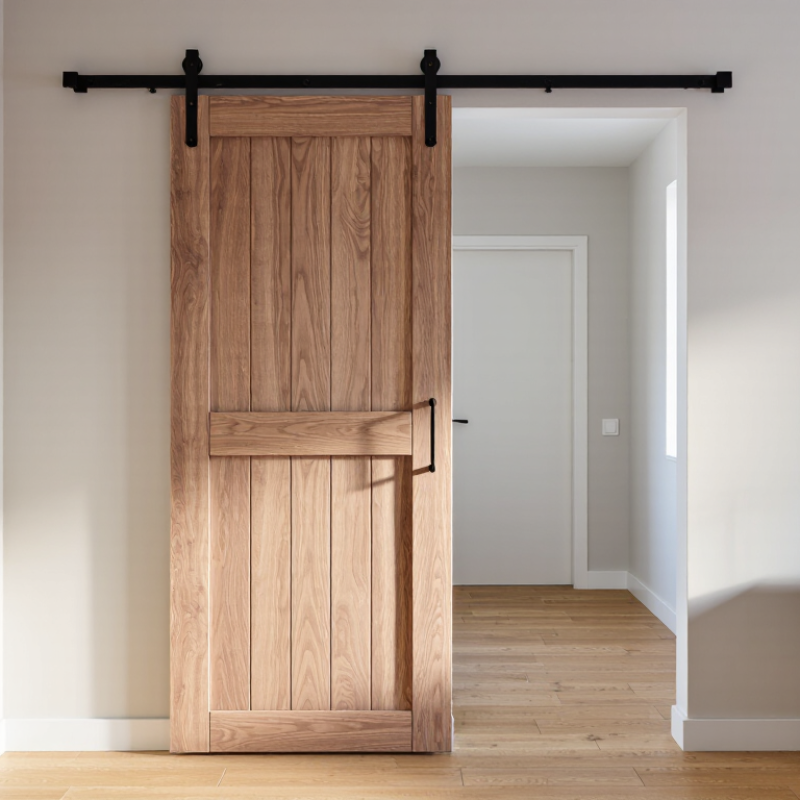
Barn Door Slabs Explained: Panels, Tracks, and Opening Basics
A barn door slab is the panel that moves across an opening; the track and rollers are usually separate parts. Panel styles range from simple flat faces to recessed panels or glass inserts. Solid wood can feel substantial, while engineered panels may be lighter and less prone to seasonal movement. Check the slab’s weight and thickness against the hardware instructions before choosing a track. That distinction matters.
The track sits above the doorway, and rollers carry the slab along it. Stoppers limit travel at each end, while a floor guide helps keep the bottom from swinging. The wall needs suitable support where the track mounts; drywall alone is not enough. Leave room above the opening for the track and rollers, and check for nearby trim, switches, or furniture. A small obstruction can stop the door from opening fully.
Measure the opening, then select a slab wide enough to overlap it on both sides. Measure twice. A sliding slab does not usually seal like a hinged door, so light, sound, and cooking smells may pass around its edges. It may also need clear wall space beside the opening equal to the door’s width. That measurement can feel fussy, but skipping it is an easy way to end up with a door that looks right and slides poorly.
Space and Accessibility: ADA 404.2.3 Sets a 32-Inch Clear-Width Minimum
A barn door can make a narrow room feel less crowded because it slides beside the wall instead of swinging into the floor area. But the slab’s listed width does not tell you the usable opening. Under ADA Standards section 404.2.3, accessible door openings generally need at least 32 inches of clear width when the door is open 90 degrees. The measurement is taken between the door’s face and the opposite stop—not from the slab’s edge.
That distinction matters. A 36-inch slab may provide less than 32 inches of clearance if its track, pulls, or overlap reduce the opening. Measure the actual passage with the door fully open. Check the handle, too; a projecting pull can catch a sleeve or limit movement. Small details matter.
A barn door may still fall short. Some designs leave gaps, lack a firm stop, or require enough wall space to slide fully clear. Also, ADA requirements apply in specific covered settings; they do not automatically govern every private home. If accessibility is important, confirm the applicable requirements with a qualified professional before ordering. I would not rely on the catalog width alone. It is an easy mistake to make.
Material Choices: Compare Wood, MDF, Glass, and Composite Slabs
A barn door slab’s material affects its weight, upkeep, privacy, and feel in the room. Solid wood brings visible grain and can be sanded or refinished when its look grows tired. It also responds to humidity, so seasonal movement may cause sticking or small gaps. Check the slab’s weight against the track’s rated capacity before buying. A beautiful door is still a poor fit if its hardware cannot support it.
MDF offers a smooth surface that takes paint evenly, making it useful for a clean, simple finish. It is often less expensive than solid wood, but damage can be difficult to repair. Keep it away from persistent moisture, especially in poorly ventilated bathrooms. Small details matter. A chipped corner may show more than expected. I would not assume that a painted slab is automatically low-maintenance.
Glass allows daylight to pass between rooms and can make a narrow hallway feel more open. Frosted or textured panels soften views, though they do not provide the same privacy as a solid slab. Composite slabs vary widely: some combine wood fibers with other materials for stability, while others prioritize lower weight or cost. Ask about construction, finish, and care rather than relying on the label alone. Compare the slab’s dimensions and weight with the opening and hardware, too. A little measurement now can prevent an awkward installation later.
Why Choose a Barn Door Slab? Compare Material Density
Typical density ranges for common slab materials, in kilograms per cubic meter (kg/m³).
Density affects how much a material weighs for a given volume: glass is much denser than the other options, while softwood is typically the lightest. Actual slab weight also depends on its dimensions and construction. Ranges are representative and vary by species and formulation.
Hardware and Operation: ADA 404.2.9 Sets a 5-lbf Opening-Force Limit
A barn door slab can save floor space, but smooth movement matters more than appearance. Under ADA Standard 404.2.9, the opening force for sliding doors is limited to 5 pounds, or about 22.2 newtons, where the standard applies. That figure is a practical accessibility benchmark when planning a home, though ADA requirements do not automatically apply to every private residence.
The number can feel surprisingly small. A heavy slab, tight track, misaligned rollers, or a dragging floor guide can make a door difficult to move. Check the door across its full travel, not just at the first pull. It should glide without a hard tug or sudden jerk. Small details matter.
The 5-pound limit concerns opening force, not every aspect of usability. A door may move easily yet still be hard to grasp if its pull is too small or poorly placed. Leave enough clear space beside the opening, and choose hardware that can be operated with one hand. Measure after installation; real-world friction can differ from a showroom sample. I would not assume a door is accessible just because it feels light on day one. Tracks collect dust, and fasteners can loosen. A simple follow-up check helps catch those changes.
Selection Factors: Weigh Privacy, Sound, Wall Space, and Maintenance
Why Choose a Barn Door Slab for Your Home?
A barn door slab can save swing space and add a clean, open feel. But check privacy before choosing one. Unlike a hinged door, it usually leaves small gaps along the sides and floor. Voices, light, and cooking smells may travel through them. For a bedroom or bathroom, that trade-off can matter more than the look. A solid, heavier slab may soften sound, but it will not seal the room.
Wall space is the next practical test. The door needs a clear stretch of wall to slide across. A light switch, thermostat, or tall bookcase can block its path. Measure the opening and the full travel area, including trim. Maintenance is modest, but not zero: dust can collect on the track, and loose hardware may cause rattling or uneven movement. I like the simplicity, though I would not call every installation effortless.
Tips: Tape the door’s travel area on the wall before buying. Stand nearby and listen for household noise. Check that the track can be reached for cleaning, and make sure the slab’s weight suits its hardware. One small detail is easy to miss: a handle may bump into nearby furniture. It happens.
