
Why Choose a Tiffin Lunch Box for Global Sourcing?
Choosing a Tiffin Lunch Box for global sourcing requires more than comparing prices and catalog images. Buyers must examine material quality, production consistency, supplier communication, and market suitability. A well-designed lunch box can support reusable food storage, portion control, and convenient meal transport. Yet these advantages depend on reliable manufacturing.
In practical sourcing work, sample inspection reveals important details. Check the lid seal, container alignment, handle strength, and surface finish. Stainless steel should be clearly identified, especially when the product touches food. Suppliers should provide suitable food-contact documentation and explain their testing procedures. Factory audits, production samples, and batch inspections can reduce avoidable quality risks. Small defects matter. A loose lid can cause leakage inside a work bag.
Global sourcing also involves packaging, labeling, shipping protection, and local customer expectations. Some buyers prefer compact stacked containers. Others need larger portions, microwave-safe materials, or dishwasher-friendly designs. These requirements should be confirmed before mass production. Supplier claims should not replace independent verification. Photographs can hide uneven welds and weak closures.
No product is perfect. A lower price may create hidden costs through returns, damaged packaging, or inconsistent batches. The real challenge is balancing durability, usability, compliance, and commercial value. Experienced sourcing teams compare several suppliers and document each decision. They also leave room for improvement after customer feedback. Choosing the right Tiffin Lunch Box is therefore a careful process, not a quick purchasing decision.
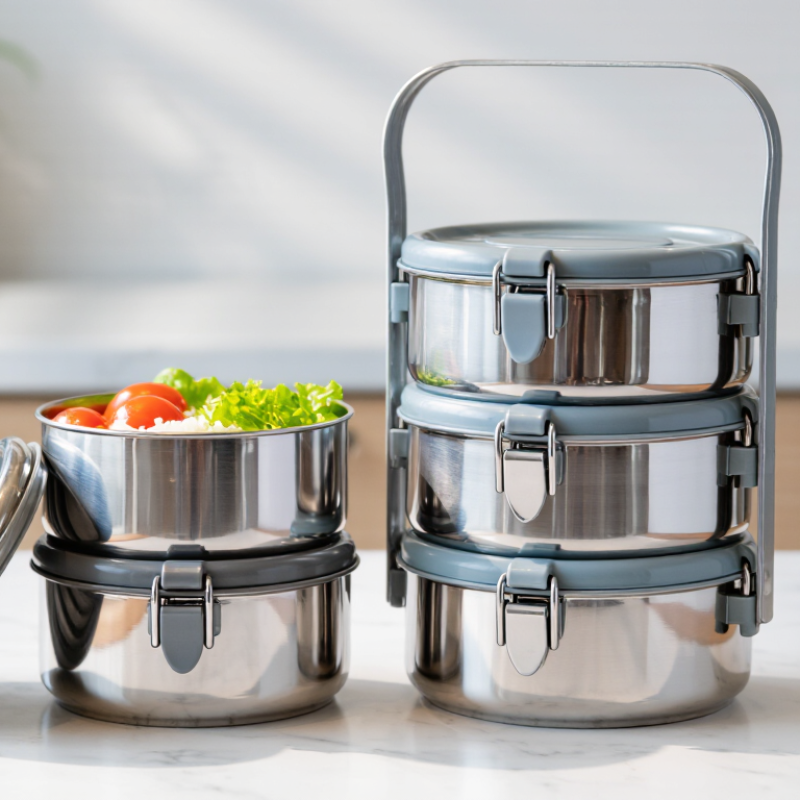
What Is a Tiffin Lunch Box?
A tiffin lunch box is a reusable food container made from separate stacked compartments. Each layer holds a different dish, such as rice, vegetables, fruit, or a small snack. The sections usually connect with a metal clip, screw ring, or fitted lid. This design keeps foods apart during transport and makes portion planning easier.
For global sourcing, buyers often examine material safety, leak resistance, durability, and cleaning access. Stainless steel is widely selected because it resists odors and tolerates repeated use. However, a tight-looking lid does not always prevent leaks. Product testing should include warm soup, gentle shaking, and several opening cycles. Measurements also matter. A container that fits one market’s lunch bag may feel inconvenient in another. Small differences can affect customer satisfaction.
Tips:
Check the seal after washing, not only when the box is new. Ask suppliers for material specifications and food-contact test documents. Review hinge strength, surface finishing, packaging protection, and replacement-part options. Clear product instructions should explain safe temperature use and hand-washing limits. Avoid assuming every stacked design suits every meal. Some foods need more space, while sauces may require a separate sealed cup. Tiffin boxes are practical, but their performance depends on thoughtful design and honest quality checks.
How Tiffin Lunch Boxes Support Global Sourcing
For global sourcing teams, a tiffin lunch box offers a practical way to standardize reusable meal packaging across markets. Its stacked design separates rice, vegetables, and sauces without requiring several loose containers. In supplier discussions, this structure makes dimensions, capacity, lid fit, and surface finish easier to specify. A sample can be packed into a shipping carton and checked before a larger order. That small step prevents expensive surprises.
Reliable sourcing depends on more than appearance. Buyers should request material documentation, food-contact test reports, and clear production tolerances. Stainless steel may suit hot meals and repeated washing, while food-grade plastics can reduce weight and freight costs. The choice depends on local customer habits. Hinges, seals, and locking clips deserve hands-on testing. Open and close them repeatedly. Drop a filled sample carefully. Measure leakage after transport simulation. These checks reflect real use, not just catalog claims.
Tiffin lunch boxes can support flexible market entry. Different compartment sizes serve office workers, students, and outdoor users, while one basic design may support several configurations. Nesting products can improve carton efficiency, although overly tight stacking may slow packing. Buyers sometimes focus on unit price and overlook inspection time, replacement parts, or inconsistent polishing. That is a weakness worth admitting. A dependable sourcing plan should compare total landed cost, factory communication, compliance records, and after-sales handling before approval.
Why Choose a Tiffin Lunch Box for Global Sourcing?
Global merchandise trade creates broad sourcing opportunities for reusable food containers. A tiffin lunch box is lightweight, stackable, reusable and suitable for multiple meal occasions, making it practical for international procurement and distribution.
2023 merchandise exports by region, rounded to the nearest US$0.1 trillion. Source: World Trade Organization, World Trade Statistical Review 2024.
Key Materials, Designs, and Product Features
Why Choose a Tiffin Lunch Box for Global Sourcing?
Design affects both user comfort and factory consistency. Stackable containers save space in kitchens, offices, and shipping cartons. Secure clips should close firmly without requiring excessive force. Silicone seals can improve leak resistance, especially for soups and sauces. However, seals need accurate sizing and stable material quality.
A loose ring creates messes.
A tight ring may frustrate users.
Useful features include insulated sleeves, separate compartments, carrying handles, and condensation control. Rounded inner corners make cleaning easier and reduce trapped food. Smooth welds also support better hygiene and a more refined appearance.
For global sourcing, suppliers should confirm carton dimensions, color consistency, logo placement, and replacement-part availability. Sample testing should include drop checks, repeated opening, hot-food contact, and dishwasher exposure when applicable.
No design is perfect. A beautiful lid can still fail if its hinge alignment changes slightly during mass production. The specification should leave room for inspection, correction, and honest feedback.
Quality, Safety, and Compliance Considerations
A tiffin lunch box can support global sourcing when quality controls begin before production. Its stacked design looks simple, yet each layer must fit securely. Food-contact materials need careful selection, especially for stainless steel, plastic, silicone, and coatings. Suppliers should provide material specifications and recent migration test reports. These documents help buyers verify that components suit the destination market.
Safety checks should reflect real daily use. Inspectors can test leakage, lid strength, hinge movement, odor, and resistance to repeated washing. Heat testing also matters when users add warm rice, soup, or curry. Small details matter. A gasket that loosens after several cycles can create contamination risks. Sharp edges may appear only after polishing or stamping. Sampling should cover different production batches, not only one attractive pre-production unit.
Compliance requires more than a certificate stored in a folder. Buyers should review factory records, inspection procedures, corrective actions, and traceability systems. Packaging materials may also require separate food-contact assessments. Experienced sourcing teams compare supplier claims with independent laboratory results and current destination-market requirements. That gap matters. A supplier may pass an initial inspection but still struggle with consistent assembly. Regular audits and retained samples can reveal this weakness earlier. Global shipping adds another concern: cartons must protect lids and stacked containers from impact, moisture, and deformation. One practical mistake remains common—testing the empty box but not the fully loaded product.
Why Choose a Tiffin Lunch Box for Global Sourcing? — Quality, Safety, and Compliance Considerations
| Evaluation Dimension | Recommended Sourcing Benchmark | Why It Matters | Evidence to Request from the Supplier |
|---|---|---|---|
| Food-Contact Material | Use food-contact-grade stainless steel, commonly grades 304 or 316, or polypropylene specifically declared for food contact. | Food-contact materials should not transfer substances to food at levels that could endanger health or adversely affect food composition, taste, or odor. | Verification Required Material specification, grade declaration, supplier declaration of compliance, and representative material test report. |
| Regulatory Food-Contact Compliance | For European sales, assess Regulation (EC) No. 1935/2004 and Good Manufacturing Practice Regulation (EC) No. 2023/2006. For plastic components, assess EU Regulation (EU) No. 10/2011 where applicable. | These rules establish the main framework for food-contact safety, traceability, and migration control in the European Union. | Market-Specific Declaration of Compliance, supporting migration test reports, intended-use statement, and traceability records. |
| United States Compliance | For U.S. imports, verify that applicable plastic or elastomer components meet the relevant FDA food-contact requirements, such as 21 CFR 177.1520 for certain olefin polymers and 21 CFR 177.2600 for repeated-use rubber articles. | Compliance depends on the actual material, additives, seal composition, temperature, and food type rather than on the product name alone. | Component-Level Review FDA compliance statement, resin or elastomer identification, test conditions, and supplier formulation declaration where available. |
| Chemical Migration | Test the finished food-contact article or representative components under conditions matching the intended food types, contact time, and temperature. | Migration performance can change when the lunch box is used with oily, acidic, salty, hot, or chilled food. | Independent Testing Preferred Overall and specific migration results, test laboratory accreditation, test conditions, and sample identification. |
| Seal and Leak Resistance | Use a silicone or other food-contact seal that remains seated after repeated opening and closing; validate with an inverted leak test using water and a representative oily food. | A secure seal reduces leakage during transport and helps prevent cross-contamination between food compartments. | Factory Validation Leak-test procedure, acceptance criteria, sample quantity, repeated-use results, and inspection records for gaskets and locking parts. |
| Temperature Suitability | Declare a tested operating range for the complete assembly, including the container, lid, coating, gasket, and locking mechanism. Do not rely only on the base material’s melting point. | Seals and plastic components may deform, harden, or lose elasticity before the metal body is affected. | Use-Condition Test Hot-food, chilled-food, microwave, freezer, and dishwasher suitability statements supported by test conditions. |
| Durability and Repeated Use | Evaluate hinge or clasp operation, stacking stability, dent resistance, surface finish, and gasket performance after repeated-use cycles defined in the purchase specification. | Tiffin lunch boxes are reusable products; failure of closures, seals, or welds can create safety and customer-service issues. | Pre-Shipment Quality Control Approved sample, functional-cycle records, drop or impact protocol where relevant, and defect classification standard. |
| Hygiene and Cleanability | Specify smooth food-contact surfaces, accessible cleaning areas, minimal crevices, removable seals where practical, and resistance to odor or staining under the intended use. | Hard-to-clean joints and permanently trapped food residues can increase hygiene risks during repeated use. | Design Review Product drawings, exploded views, cleaning instructions, dishwasher-cycle validation if claimed, and visual inspection criteria. |
| Heavy Metals and Restricted Substances | Control lead, cadmium, mercury, hexavalent chromium, and other restricted substances in coatings, pigments, solder, plating, and accessories according to the destination market. | Restricted substances may be present in surface coatings, decorative finishes, pigments, or non-food-contact accessories even when the main body is stainless steel. | Risk-Based Testing Restricted-substance declaration, coating specification, supplier material list, and laboratory screening for high-risk components. |
| Traceability and Batch Control | Assign a production lot or date code to finished goods and retain records linking the lot to raw materials, production date, inspection results, and shipment quantity. | Traceability supports targeted corrective action, complaint investigation, and product recall management. | Supply-Chain Control Lot-code format, production records, inspection report, retention period, and documented complaint-handling process. |
| Packaging and Transit Protection | Use packaging that prevents scratches, deformation, contamination, and movement of loose components during international transport. | Transit damage can compromise seals, closures, surface hygiene, and the appearance required for retail sale. | Shipment Validation Approved packaging specification, carton drop or vibration test where appropriate, loading photographs, and pre-shipment inspection results. |
| Supplier Documentation Readiness | Require a technical file covering drawings, bill of materials, intended use, care instructions, test reports, declarations, and change-control procedures. | Complete documentation makes global sourcing decisions more reliable and simplifies customs, retailer, and regulatory reviews. | Procurement Gate Document checklist, revision-controlled specifications, signed declarations, laboratory reports, and written notification of material or process changes. |
Note: The benchmarks above are practical sourcing criteria rather than universal legal limits. Final requirements should be confirmed against the destination market, intended food types, temperature range, cleaning method, and the complete product construction.
How to Evaluate Suppliers and Place Orders
Why Choose a Tiffin Lunch Box for Global Sourcing?
How to Evaluate Suppliers and Place Orders
A tiffin lunch box offers separated compartments, compact stacking, and reusable storage. These features suit meal-preparation users and reduce dependence on disposable packaging. For global sourcing, however, product design is only the starting point. Supplier verification matters more.
Request business licenses, factory photos, audit records, and recent food-contact test reports. Check stainless steel grades, gasket materials, weld quality, and lid durability. A polished sample can still hide weak production controls. I would order samples from at least three suppliers, then compare leakage, odor retention, hinge strength, and cleaning performance.
Use a written specification sheet. Include dimensions, compartment volume, tolerance limits, packaging, labeling, and inspection standards. ISO 2859-1 can guide acceptance sampling for bulk orders. The World Bank’s 2023 Logistics Performance Index assessed 139 economies, showing why destination-country logistics should influence supplier selection. A low-cost factory is not always the lowest-risk choice.
UNCTAD reports that more than 80% of global merchandise trade moves by sea. Shipping delays can therefore affect launch schedules and inventory costs. Confirm production capacity, lead time, port options, and backup materials before signing. Place a small trial order first. It exposes mistakes cheaply.
Payment terms deserve equal attention. Link final payment to inspection approval, not only shipment. Ask for corrective-action records when defects appear. Suppliers may resist this step, but vague promises create expensive disputes. My own recommendation would still need adjustment by market, material, and order size. That uncertainty should be recorded, not ignored.
