
Request A Quote

Phone: 416-244-6476
Email:

    Why Are CPO and NPO FAUs Important for Buyers?

    Why Are CPO and NPO FAUs Important for Buyers?

    As bandwidth demand rises, buyers must evaluate more than optical speed. They must also consider how fibers connect, align, and remain stable beside high-density photonic engines. A CPO/NPO FAU—the fiber array unit used with co-packaged or near-packaged optics—helps define that physical interface. Small alignment errors matter. So do connector access, assembly yield, and repair options.

    Industry research provides useful context. Yole Group’s optical-transceiver market analysis tracks the growth and evolution of high-speed datacom optics. OIF’s Co-Packaging Framework Document describes the system-level challenges of bringing optical and electronic functions closer together. Neither source makes every FAU interchangeable. Buyers should compare fiber count, pitch, end-face quality, coupling loss, tolerances, and qualification data against their actual platform.

    LightCounting CEO Vladimir Kozlov is a recognized analyst of optical communications markets. His public market commentary can be paraphrased as a buyer’s reminder: demand forecasts matter, but product choices still depend on deployment economics and implementation readiness. That distinction is easy to overlook. Ask suppliers for measured insertion-loss distributions, alignment tolerances, environmental test results, and a clear rework process. Request evidence from the intended package, not only a polished laboratory demonstration. A few clean samples are not production proof. And specifications alone cannot reveal how an assembly behaves during installation or service. For buyers, the CPO/NPO FAU is therefore not a minor accessory; it is a practical determinant of optical performance, manufacturability, and long-term maintainability.
    Why Are CPO and NPO FAUs Important for Buyers?

    What Are CPO and NPO Fiber Array Units?

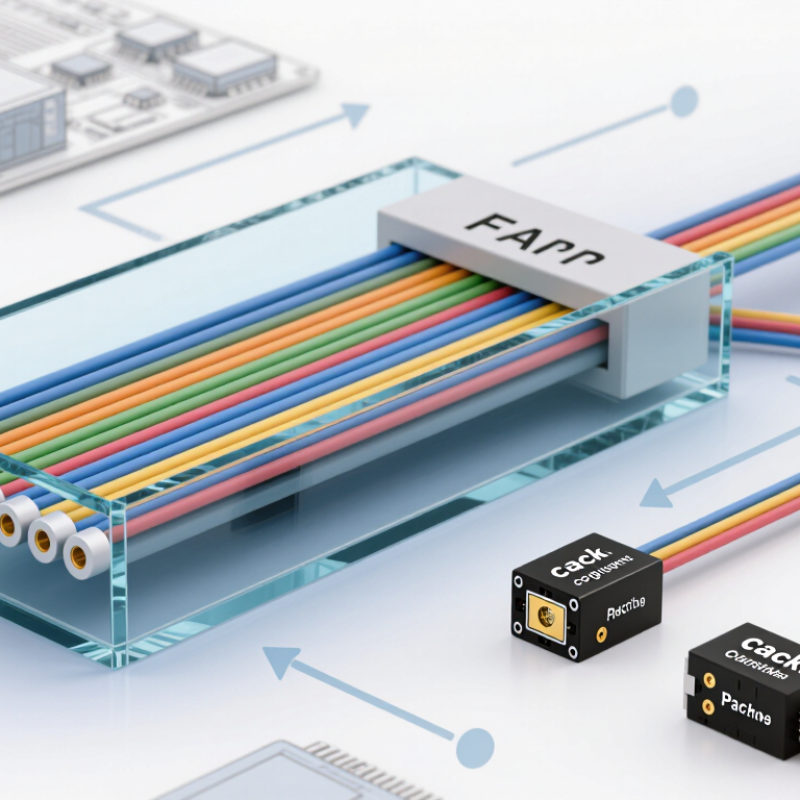
    CPO and NPO fiber array units, or FAUs, are precision assemblies that position multiple optical fibers beside photonic components. Each fiber must meet a tiny optical port with controlled spacing and angle. A glass array, alignment features, and a protective housing help maintain that position. Small errors can weaken the optical signal.

    In co-packaged optics (CPO), optical engines sit close to switching or computing chips within the same package. Near-packaged optics (NPO) places them nearby, but typically outside that package. In both designs, FAUs provide the physical fiber interface. They help route light between the photonic engine and external fiber connections. The exact arrangement depends on the system.

    For buyers, the label alone says little about fit. Check fiber count, pitch, end-face quality, connector style, and alignment tolerances against the intended optical engine. Ask how performance is measured and whether results cover temperature changes and assembly variation. Small details matter. A drawing may look correct while the finished unit proves difficult to install. This part is easy to underestimate. It is also worth confirming handling requirements, since a clean end face and stable mounting affect repeatable coupling. Specifications can feel less tidy than expected, so request clear test conditions before comparing suppliers.

    Why CPO and NPO Fiber Array Units Matter to Buyers

    Fiber array units (FAUs) align multiple optical fibers with an optical engine. CPO places the optical engine in the same package as the switch ASIC, while NPO places it near the package. The chart shows this placement as an ordinal category—not a physical distance or a product specification. Buyers can use the distinction to assess packaging, fiber routing, alignment, and serviceability requirements.

    How FAUs Connect Optical Engines to Fiber Networks

    Why Are CPO and NPO FAUs Important for Buyers?

    A fiber-array unit, or FAU, forms the physical bridge between an optical engine and the fiber network. It holds several fiber ends at precise spacing, then aligns them with tiny optical ports on the engine. In co-packaged optics, the engine sits beside the switch ASIC; in near-packaged optics, it sits close by. Either way, light must cross this short interface with low loss and stable alignment. A fraction of a millimeter matters.

    The demand behind these links is growing. Cisco’s Annual Internet Report (2018–2023) projected global IP traffic would reach 396 exabytes per month in 2022, compared with 122 exabytes per month in 2017. That matters. Higher traffic pushes buyers to examine more than port speed. They should check FAU channel count, fiber type, connector access, insertion loss, and alignment tolerances against the optical engine’s specifications. Dust on a fiber end can also spoil a link, even when the assembly looks clean.

    For CPO and NPO systems, buyers should ask how the FAU is attached and tested, and whether its performance remains stable through temperature changes and handling. Request measured loss data across channels, not only a single best result. The awkward part is that a neatly aligned prototype may not reflect production variation. Some specifications also leave room for interpretation. Check the test conditions before comparing suppliers.

    How CPO and NPO Architectures Shape FAU Requirements

    Why Are CPO and NPO FAUs Important for Buyers?
    How CPO and NPO Architectures Shape FAU Requirements

    Co-packaged optics (CPO) places optical engines close to the switch ASIC. This saves electrical trace distance, but leaves little room for fiber routing and service access. The FAU must match the engine’s fiber count, pitch, and coupling interface. Small alignment errors can reduce optical performance across multiple channels. Heat and mechanical movement also deserve attention.

    Near-packaged optics (NPO) positions optical engines near, rather than inside, the main package. This can allow different fiber paths and simplify access, but board space and bend limits still matter. Buyers should compare FAU designs against the actual layout, not just a channel-count specification. Ask for alignment tolerances, insertion-loss data, and details of how the assembly is tested. A clean lab setup can be misleading; real routing may be less forgiving.

    Tips: Request a sample FAU with the intended fiber exit direction. Check clearance, bend radius, and handling steps in a representative assembly. If these details are unclear, pause and ask. A few millimeters can change the fit.

    Why Are CPO and NPO FAUs Important for Buyers? - How CPO and NPO Architectures Shape FAU Requirements

    Buyer Evaluation Dimension CPO (Co-Packaged Optics) NPO (Near-Packaged Optics) What to Confirm About the FAU
    Optical-engine placement Optical engines are positioned on or very close to the switch package, reducing the electrical distance between the switch ASIC and optics. Optical engines are placed near the switch package but remain separate from it, typically allowing more physical separation than CPO. Confirm the FAU interface and fiber exit direction are designed for the actual optical-engine location and system layout.
    Fiber routing and egress Fibers must be routed from a highly integrated package area to the chassis or external optical interface. Tight space and bend management can be important. The separate optical-engine location may provide more routing space, although chassis dimensions and cable paths still constrain the design. Review the complete fiber path, minimum bend radius, strain relief, connector access, and clearance in the assembled system.
    Port and channel density High-density integration can make compact, accurately positioned fiber interfaces important, especially where many optical channels converge near the package. Density depends on the optical-engine arrangement and system design; a separate location may offer more freedom in arranging fibers. Check the number of fibers, pitch, fiber type, channel mapping, and whether the FAU can be assembled and inspected at the required density.
    Alignment and coupling Small packaging envelopes and close integration can make repeatable alignment between the FAU and optical interface a key assembly consideration. Alignment requirements are set by the optical interface and mechanical stack-up; a separate module may permit different assembly and adjustment approaches. Request alignment tolerances, coupling-loss limits, inspection methods, and evidence of performance across production builds.
    Thermal and mechanical environment The FAU and its fiber attachment may be exposed to a crowded package region with nearby heat sources and limited mechanical clearance. Greater separation from the switch package may ease some placement constraints, but local temperature, vibration, and airflow still need assessment. Validate the FAU and fiber-attach design against the system’s temperature range, thermal cycling, vibration, and mechanical shock requirements.
    Assembly and test strategy Package-level integration can require close coordination of optical-engine placement, fiber attachment, and final system assembly and test. A separately located optical module can support a more modular assembly flow, depending on the product’s interface and manufacturing design. Ask where alignment, optical testing, and rework take place, and how yields and traceability are managed at each manufacturing step.
    Serviceability and replacement Because optics are closely integrated with the switch package, field replacement may be more limited and may depend on the system’s service model. A separate optical module may be easier to access or replace, if the design provides suitable connectors and service procedures. Confirm whether the FAU is replaceable, how fibers are disconnected or protected, and what repair level is supported.
    Customization and change control Changes to FAU geometry or fiber routing can affect a tightly integrated package and may require coordinated mechanical and optical requalification. Module-level separation can offer more design flexibility, but interface changes may still affect system compatibility and qualification. Define controlled drawings, interface specifications, change-notification rules, and qualification requirements before production.
    Reliability and qualification Qualification should cover the FAU, fiber attachment, and package-level interactions under the intended operating and environmental conditions. Qualification should cover the FAU and optical module as well as their connections and system-level operating conditions. Review test plans and results for optical performance, thermal cycling, humidity where applicable, vibration, and fiber-attachment durability.
    Total cost of ownership Assess the FAU’s contribution to package assembly, yield, test time, repair strategy, and system integration—not just its unit price. Assess the FAU alongside module assembly, cabling, service access, replacement, and system qualification costs. Compare lifecycle cost, supply continuity, manufacturing yield, test coverage, and support requirements for the complete optical path.

    Buyer note: CPO and NPO describe different levels of optical integration. Exact FAU requirements—including fiber count, pitch, alignment tolerances, routing limits, and qualification conditions—depend on the specific optical interface and system design.

    What Buyers Should Evaluate When Choosing an FAU

    When choosing a fiber array unit (FAU) for co-packaged or near-packaged optics, buyers should look beyond channel count. Pitch, fiber type, connector interface, and coupling geometry must match the optical engine and the assembly process. A mismatch can turn a compact design into a costly alignment problem. Small details matter.

    The IEEE 802.3ck standard defines electrical interfaces supporting 100 Gb/s per lane, illustrating the demanding signal rates behind newer data-center links. Cisco’s Annual Internet Report (2018–2023) projected global IP traffic at 396 exabytes per month by 2022. These figures do not specify FAU performance, but they show why stable, scalable optical connections matter. Ask suppliers for measured insertion loss and return loss across every channel, not just a best-case sample. Check how results change after thermal cycling and repeated mating.

    Ask for alignment tolerances, inspection records, and test conditions. A low-loss figure is hard to compare when measurement methods differ. Request sample data from multiple units and lots. Also examine fiber protrusion, end-face quality, adhesive placement, and strain relief under magnification. These details affect assembly yield and field reliability. Do not rely on a datasheet alone. A buyer should confirm that the FAU fits the actual package, production equipment, and repair strategy.

    One uncomfortable question remains: can the supplier reproduce the same optical performance at production volume?

    How FAU Performance Influences Reliability, Scalability, and Cost

    In CPO and NPO switches, a fiber array unit (FAU) positions multiple fibers against optical ports. Its alignment, end-face quality, and insertion loss affect how consistently light reaches each channel. Small errors compound. Poor coupling can consume optical power margin and make links more sensitive to temperature changes or vibration. CPO places optics beside the switch chip; NPO keeps them nearby but separately packaged. In both designs, stable fiber alignment matters.

    The IEA’s Electricity 2024 report estimates that data centers used about 460 TWh globally in 2022, with demand potentially exceeding 1,000 TWh by 2026. The U.S. Department of Energy’s 2024 data-center energy report estimates U.S. consumption at 176 TWh in 2023, possibly reaching 325–580 TWh by 2028. These figures do not prove that better FAUs reduce facility energy use. They do show why efficient, dependable optical links are increasingly valuable. Lower coupling loss can help preserve link budgets, but the full system design determines actual power savings.

    For buyers, repeatable FAU placement can improve manufacturing yield and reduce calibration, rework, and field-replacement costs. It also supports scaling: more fibers and denser optical connections demand tight pitch control and consistent assembly. Yield matters. Ask suppliers for measured insertion-loss distributions, alignment tolerances, and thermal-cycle results—not just a best-case value. One caveat: a precise FAU cannot compensate for contaminated connectors, weak packaging, or poor maintenance. Those details are easy to underestimate.

    Article Source: